
Price Action | Structure and Behavior-Based Trading

Category: Articles

The neuroscience of trading and psychological factors behind financial decision making
Articles

The Neuroscience of TradingPsychological and Behavioral Drivers of Financial Decision-Making

Psychology Introduction In financial markets, success in trading is not limited to economic knowledge, chart analysis skills, or the ability to recognize price structures. A significant part of a trader’s performance depends on how information is processed, how decisions are made under uncertainty, and how psychological responses are managed. Unlike

ادامه مقاله »
Why trading is prohibited in banking institutions and financial risk management
Articles

Why Is Trading Prohibited in Banking Institutions?

Examining the Challenges, Misconceptions, and Presenting an Alternative Model for Using Non-Deposit Resources in Low-Risk Trading Activities Abstract This article examines the theoretical, legal, and institutional foundations behind the prohibition of trading activities within banking institutions. It highlights the structural conflict between the primary role of banks as financial intermediaries

ادامه مقاله »
اقتصاد ترس (Fear Economy)
Articles

Fear Economy

Why War News Moves Markets More Than War Itself Abstract In modern financial markets, prices move less according to current realities and more according to future expectations. Among various market drivers, news related to wars and geopolitical tensions represents one of the strongest psychological catalysts. The key point is that,

ادامه مقاله »
Articles

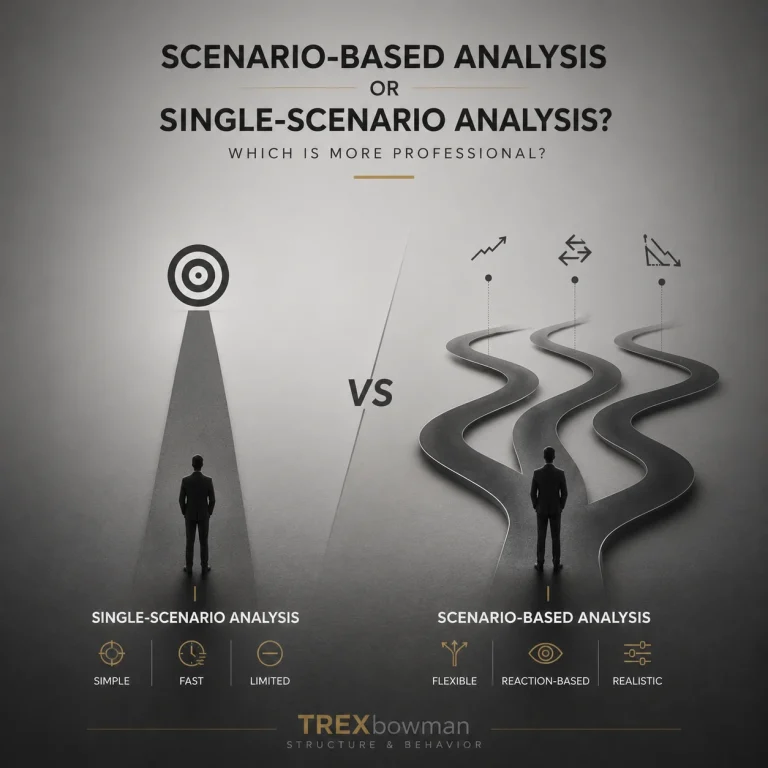
Scenario-Based Analysis vs. Single-Scenario Analysis: Which Approach Is More Professional?

Introduction: Two Approaches to Understanding Market Behavior In financial markets, analysts generally follow two different approaches when evaluating future price movements. Some analysts rely on a single-scenario approach, where they define one expected path for price movement and build their decisions around that assumption. Others use a scenario-based analysis approach,

ادامه مقاله »