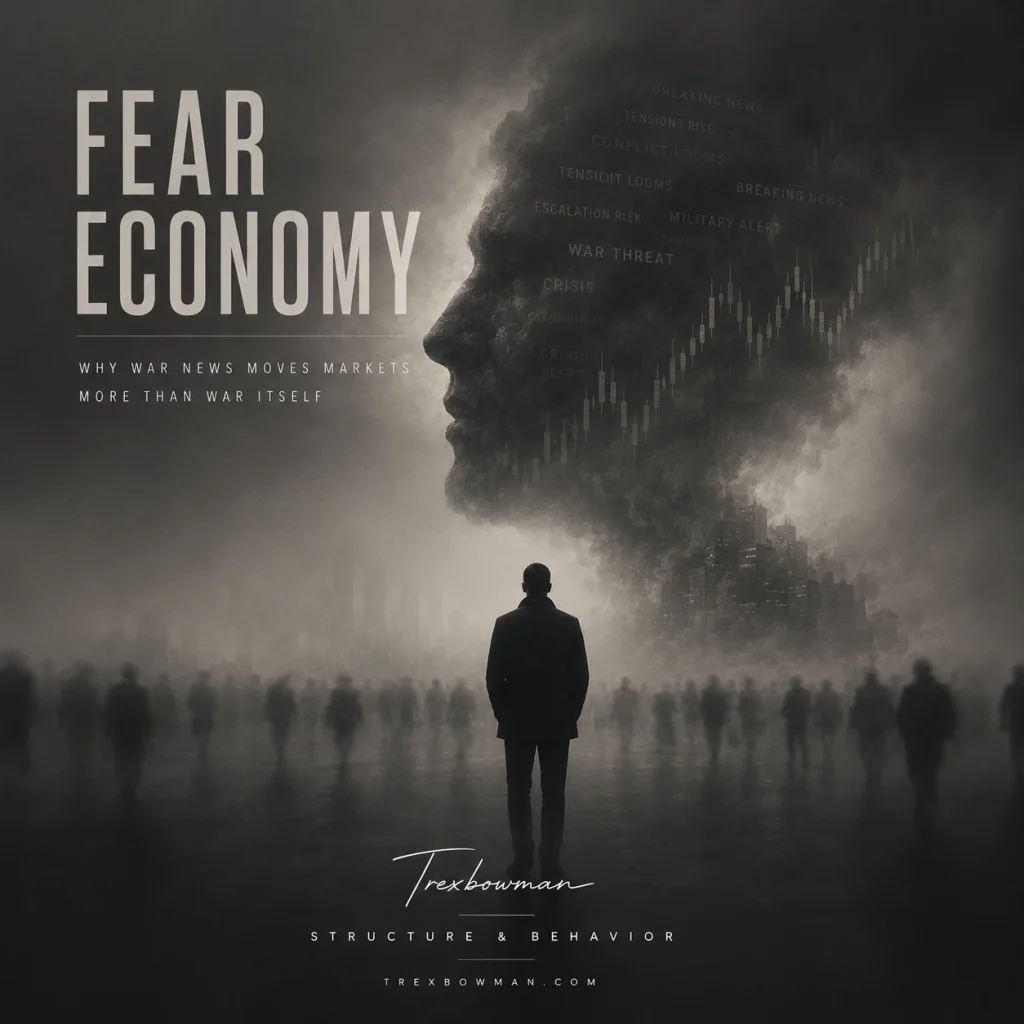
Why War News Moves Markets More Than War Itself
Abstract
In modern financial markets, prices move less according to current realities and more according to future expectations.
Among various market drivers, news related to wars and geopolitical tensions represents one of the strongest psychological catalysts. The key point is that, in many cases, the military event itself is not the primary factor behind market movements. Instead, it is the fear of its occurrence that causes significant shifts in prices.
This article explores the concept of the Fear Economy and explains how media, collective psychology, and market behavior interact to create exaggerated reactions in assets such as gold, oil, and currencies.
Keywords
Fear Economy, Market Psychology, Geopolitical Risk, War Impact on Markets, Behavioral Finance, Market Perception, Safe Haven Assets, Gold Price Analysis, Oil Market, Market Sentiment, Herd Behavior, Market Decoupling, Financial Markets
Introduction
Financial markets never react solely to actual data.
If they did, prices would always move only after news events occurred. However, in reality, markets have repeatedly shown strong reactions before the main event actually happens.
This phenomenon becomes especially visible during war-related news and geopolitical crises. Sometimes, the mere possibility of conflict is enough to trigger major market reactions. Safe-haven assets begin to rise, risk appetite declines, and capital starts moving between different markets.
Markets operate based on a simple but powerful principle:
“What matters is not reality itself, but the market’s perception of reality.”
Markets Price the Future
In the field of Behavioral Finance, including the works of Daniel Kahneman and Amos Tversky, it is emphasized that humans tend to make fast and emotional decisions under conditions of uncertainty.
Markets are created by these same humans.
Therefore:
Market = Collective decisions of individuals
Human = A combination of fear + hope + cognitive bias
The result:
Markets are constantly pricing the probable future, not the current reality.
The Power of Uncertainty Is Greater Than the Event Itself
In many cases, an unclear piece of information such as:
- The possibility of an attack
- Political tensions
- Diplomatic conflicts
can move markets more strongly than the actual war itself.
Why?
Because markets fear an uncertain scenario, not a confirmed reality.
Uncertainty creates multiple possible outcomes, and the market begins pricing those possibilities before they become reality.
The Role of Media in Amplifying Fear
Media outlets are not only transmitters of information; they are also powerful amplifiers of market emotions.
The main characteristics of media-driven fear include:
- Continuous repetition of news
- Highlighting potential risks
- Simplifying complex crises
The result:
A limited event → transforms into a global crisis in the market’s perception
The market does not only react to what happens; it reacts to how strongly that event is perceived.
Herd Behavior
When fear enters the market:
- Individual analysis decreases
- Decisions become emotional
- Traders begin following the movement of the crowd
The result:
Short-term, extreme, and irrational volatility appears in markets such as domestic 18-karat gold.
During these periods, many market participants are no longer analyzing probabilities; they are simply reacting to collective fear.
Market Decoupling
One of the most important concepts often ignored in superficial analysis is that markets do not always move in the same direction.
Under normal conditions:
- Global Gold Spot
- Domestic Iranian gold
- The dollar
- Oil
should maintain a relative correlation.
However, during crises or periods of internal economic and currency pressure, these correlations can break down.
Real Market Examples
The Russia-Ukraine War (2022)
Even before the official beginning of the conflict:
- Oil prices experienced a sharp increase
- Gold entered a bullish phase
- Equity markets came under pressure
The important point:
A significant portion of the movement occurred before the first military operation began.
Markets were not reacting only to the war itself; they were reacting to the expectation and fear surrounding it.
Middle East Tensions
During many regional crises:
Oil and currency markets often react immediately after the release of tension-related news, even if the conflict remains limited.
The market usually begins by pricing the worst-case scenario.
Financial Crises and Federal Reserve Decisions
Even in macroeconomic events, markets often move based on expectations and speculation before official announcements.
Examples include:
- CPI
- NFP
- FOMC decisions
Markets usually complete a significant part of their movement before the actual news release.
A Real Example:
Global Gold Rising, Domestic 18-Karat Gold Falling
In some periods, we observe:
- Global gold (XAUUSD) moving upward
- Domestic 18-karat gold in Iran moving downward
At first glance, this appears contradictory.
However, it reveals an important principle:
Domestic markets are not controlled only by global gold prices.
The domestic gold price is determined by a combination of several factors:
- Global gold price
- Domestic exchange rate
- Inflation expectations
- Domestic market liquidity
- Selling pressure or short-term policies
Therefore:
An increase in global gold prices can be neutralized by a decline in the domestic dollar rate.
Or:
A decrease in domestic demand can create downward pressure on prices.
This situation clearly demonstrates that:
Markets are not a single unified system. They are networks of connected but independent markets.
This is why:
- Analyzing only one asset, such as gold, can lead to incorrect conclusions.
- A multi-variable approach is essential.
Key Analysis
Markets are constantly positioned between two forces:
Reality
and
Perception of Reality
However, the important point is:
Markets always give more weight to perception.
Price movements are often driven not by what has happened, but by what market participants believe may happen.
Conclusion
The Fear Economy demonstrates that in modern financial markets, the news itself is not the decisive factor; rather, it is the market’s interpretation of the news that determines price reactions.
In reality:
War is not the most important factor.
The possibility of war is.
Fear of the future is one of the strongest engines behind market movements.
This is why many major market moves do not occur when a crisis actually happens, but rather when fear of that crisis begins spreading.
Understanding this mechanism allows traders to separate emotional market reactions from the deeper forces driving price movements.
References
- Daniel Kahneman — Thinking, Fast and Slow
- Amos Tversky — Prospect Theory
- Robert Shiller — Irrational Exuberance
- George Soros — Theory of Reflexivity
- Behavioral Finance Literature (Journal of Finance / NBER Papers)
- IMF Global Financial Stability Reports (Various Editions)
TREXbowman
Structure & Behavior (S&B)
@trexbowman_sb