The Hidden Logic of Markets
For years, one statement has been repeated so often that many traders have accepted it as an unquestionable truth:
“The market is completely unpredictable.”
But perhaps the problem is not the market itself—it is the way we look at it.
Most traders perceive the market as a single, unified entity. Naturally, this leads them to one conclusion:
Nothing can be predicted.
In my view, this perspective is incomplete.
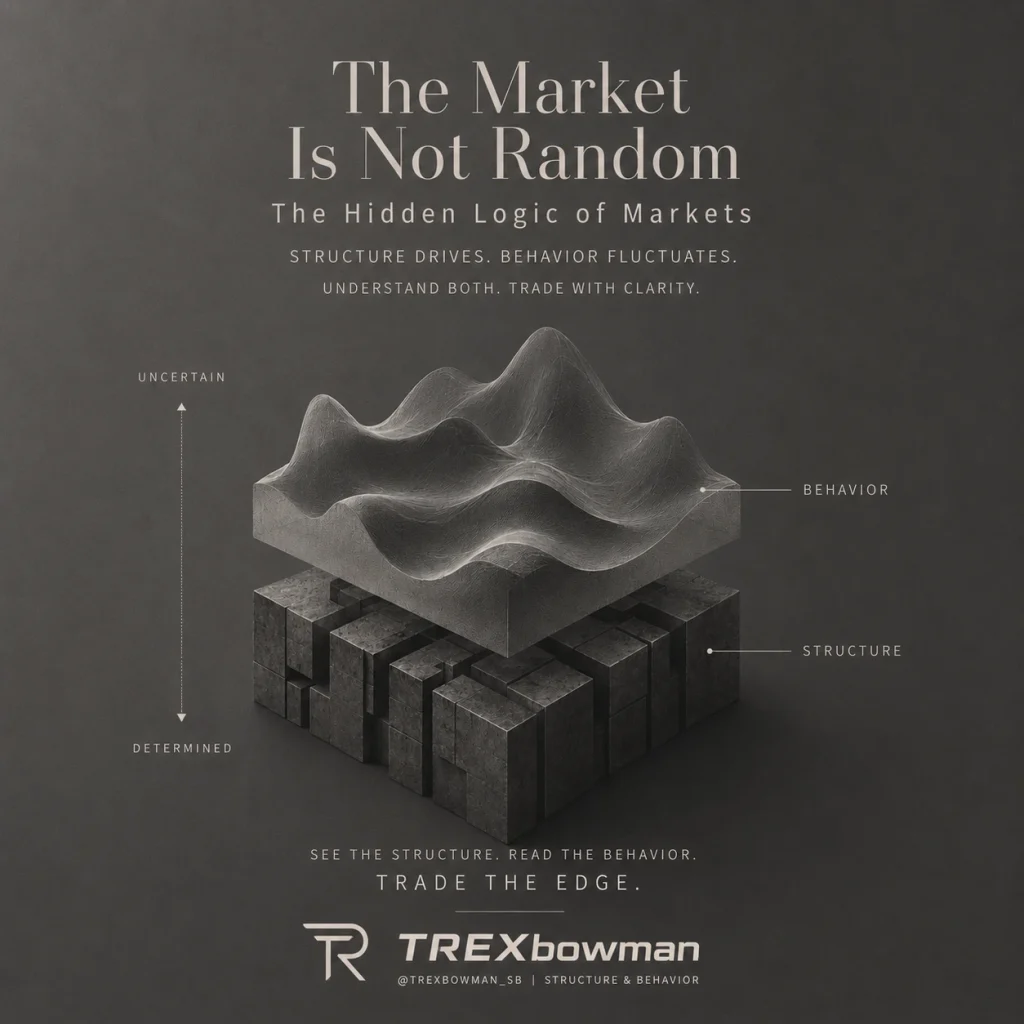
The market consists of two distinct layers: Structure and Behavior—its skeleton and its muscle.
Years of studying, observing, and analyzing financial markets led me to a different conclusion. The real challenge is not the market itself, but our understanding of it. Based on this idea, I developed the Structure & Behavior (S&B) analytical framework.
Unlike the common belief that markets are entirely random, the S&B framework recognizes that some aspects of the market are deterministic while others are variable. Instead of treating the market as a single phenomenon, it analyzes it through two separate yet interconnected layers: Structure and Behavior.
Structure is the rule-based foundation of the market. It defines the primary paths along which price is likely to travel. This layer is not driven by traders’ short-term emotions. Rather, it follows an underlying order that repeatedly appears throughout different market cycles.
Behavior, by contrast, is the market’s dynamic and ever-changing layer. The speed of price movement, the appearance of candlesticks, the depth of pullbacks, the time required to reach objectives, and even the market’s reaction to news (which is irrelevant within this framework) can all vary without changing the underlying Structure.
This is precisely why the S&B methodology does not rely on news analysis. Instead, future market possibilities are anticipated through scenario planning long before events unfold.
This also explains why so many traders believe the market is unpredictable: they focus almost exclusively on Behavior, while overlooking Structure.
If you only observe Behavior, the market seems to present a different face every day.
But once you learn to recognize Structure, you begin to see that beneath all this changing behavior lies an underlying order that continues to repeat itself.
Mastering both Structure and Behavior enables you to identify where the market currently stands within its cycle. That understanding significantly reduces emotional decision-making and impulsive trading.
From my perspective, the fundamental question is not:
“Is the market predictable?”
The real questions are:
Which part of the market is predictable, and which part is not?
Or,
Which part of the market is governed by Structure, and which part is governed by Behavior?
Answering these questions completely transformed the way I approach trading.
Within the Structure & Behavior (S&B) framework, Structure defines the destination of price movement, while Behavior determines the path price takes to reach that destination.
For this reason, my objective is not to predict every price fluctuation or every news event. My focus is to identify the underlying Structure that drives the market. Once that Structure is fully established, its structural objectives become identifiable. Behavior merely determines how the market reaches those objectives—it does not necessarily change the objectives themselves.
Perhaps the greatest misconception in trading has been treating Structure and Behavior as if they were one and the same.
As long as these two concepts remain inseparable, the market will appear either completely random or perfectly predictable.
From the perspective of the S&B framework, however, neither interpretation reflects reality.
I no longer attempt to predict every detail of price movement, because Behavior is inherently variable.
At the same time, I do not consider Structure to be random, because I have repeatedly observed that structural objectives are ultimately fulfilled, regardless of the path price follows.
Therefore, the most important question for me is not:
“How will price move today?”
Instead, it is:
“What has the market Structure already made inevitable?”
The concepts of Structure and Behavior have existed for many years across various disciplines.
What I have developed is an analytical framework that brings these two concepts together through clearly defined principles, relationships, and rules, and applies them to the analysis and interpretation of financial markets.
The market is neither random nor completely predictable.
Structure defines the destination. Behavior defines the path.
TREXbowman
Structure & Behavior (S&B)
@trexbowman_sb