
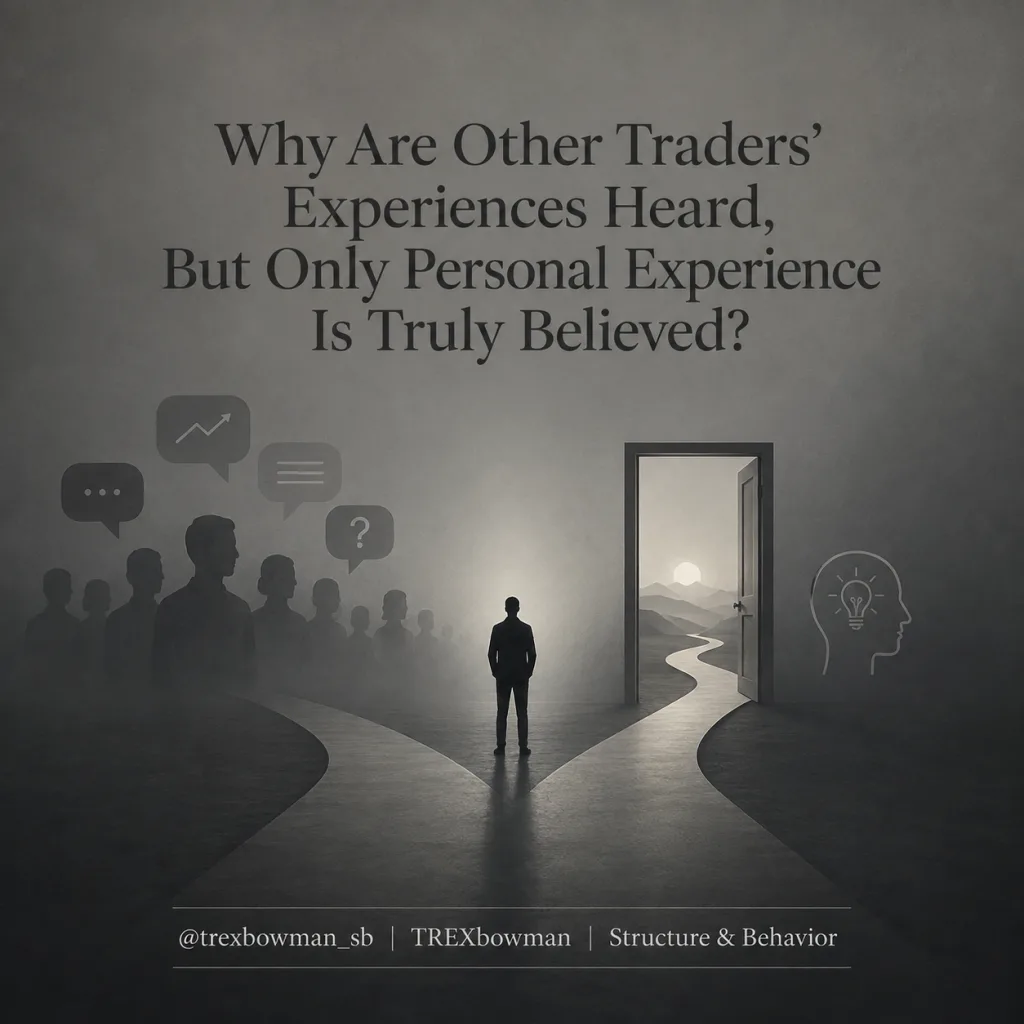
Introduction
Financial markets are among the few fields where the experiences of different generations of traders have been extensively recorded and passed on. Hundreds of classic trading books, thousands of analytical articles, interviews with successful traders, and various educational programs all repeat a common set of principles: risk management, emotional control, having a trading plan, and avoiding impulsive decisions.
However, despite this enormous amount of accumulated experience and transferred knowledge, many beginner traders continue to repeat the same mistakes that others have experienced countless times before. Many of them take excessive risks, make emotional trades, ignore stop-losses, or develop overconfidence after a few initial successes.
This raises an important question:
If the experiences of others are available, why do traders still have to learn many market lessons through personal cost and experience?
The answer can be found in the combination of human psychology, cognitive biases, and the unique structure of financial markets.
1. The Nature of Human Learning Under Uncertainty
Human learning in many areas develops through direct experience. Although knowledge can be transferred through education, study, and observation, a deep understanding of concepts often emerges only when individuals personally face the consequences of their decisions.
In financial markets, many important principles initially appear as theoretical advice. For example, a beginner trader may repeatedly hear about the importance of risk management. They understand that they should not put a large portion of their capital at risk in a single trade.
However, until they personally experience the consequences of a high-risk decision, this principle often remains only theoretical knowledge.
From a cognitive psychology perspective, direct experience activates emotional memory. When a real loss occurs, that experience is stored in memory together with strong emotions such as stress, fear, or disappointment.
It is this combination of experience and emotion that transforms a trading lesson into a deeply held belief.
2. The Gap Between Knowing and Believing
One of the important concepts in behavioral finance is the difference between “theoretical knowledge” and “practical belief.”
Many traders know the correct principles of trading, but this knowledge does not always translate into their actual behavior.
For example, almost every trader understands that using a stop-loss is essential. However, in practice, many traders move their stop-loss when the price reaches that level or keep a trade open without a clear plan.
This happens because, at the moment of decision-making, emotions can overpower theoretical knowledge. Until individuals personally experience the real consequences of these decisions, trading principles are not fully internalized.
In behavioral finance, this gap between knowledge and behavior has been widely studied. Research shows that even professional investors sometimes make decisions under psychological pressure that contradict their previous knowledge and experience.
3. Cognitive Biases in Trading
Studies in behavioral finance, developed by researchers such as Daniel Kahneman and Amos Tversky, show that human financial decisions are often influenced by cognitive biases.
These biases can cause individuals to ignore the experiences of others.
3.1 The Illusion of Being an Exception
One common cognitive bias is the belief that one is an exception.
Many traders assume that the mistakes made by others will not necessarily happen to them.
For example, a trader may hear stories about significant losses caused by excessive leverage, but believe that with better analysis and more careful decisions, they can avoid the same risks.
This mindset causes warnings from experienced traders to be taken less seriously.
3.2 Overconfidence
Overconfidence is one of the most recognized cognitive biases in financial markets.
Many traders, after a few successful trades, begin to believe they have developed a deep understanding of the market.
Behavioral finance research has shown that overconfident investors usually trade more frequently and accept higher levels of risk, while their long-term performance is often weaker compared to more cautious traders.
4. The Deceptive Structure of Financial Markets
Financial markets are environments where the relationship between decisions and outcomes is not always direct.
This characteristic makes learning from others’ experiences more difficult.
4.1 When Markets Reward Wrong Behavior
Sometimes a trader enters a position without a clear plan or proper risk management and accidentally achieves a significant profit.
Such an experience can create the illusion that their behavior was correct.
For example, during strong bullish periods in stock markets, many inexperienced investors may generate substantial profits without conducting deep analysis.
This early success can cause them to underestimate the real risks of the market.
A clear example of this phenomenon was observed during the Dot-com Bubble in the late 1990s.
5. The Role of Emotions in Trading Decisions
Financial markets are environments where human decision-making is strongly influenced by emotions. Unlike many economic activities where there is sufficient time for analysis and evaluation, financial markets are often accompanied by rapid price movements and instant decisions.
When prices rise or fall quickly, the emotional system of the human brain becomes activated. In such situations, the human mind tends to react quickly rather than calmly perform logical analysis.
This is why many trading decisions are made under the influence of emotions such as fear, greed, hope, or excitement rather than through careful analysis.
In reality, many common trading mistakes do not occur because of a lack of analytical knowledge, but because of the inability to regulate emotions (Emotional Regulation). Even traders with a high level of market knowledge may make decisions under psychological pressure that are inconsistent with their trading plan.
5.1 Fear in Trading
Fear is one of the most powerful emotions affecting traders’ behavior.
In financial markets, fear usually appears in the form of fear of loss or fear of losing capital. One common result of this fear is exiting profitable trades too early.
When a trade moves into profit, many traders become afraid that the market may suddenly reverse and eliminate their gains. As a result, they close their positions too early and do not allow their profits to grow.
On the other hand, the same fear can create a contradictory behavior in losing trades.
When a position moves into a loss, many individuals are afraid of accepting their mistake. Closing the trade means accepting the loss, and this is often psychologically difficult for the human mind.
As a result, the trader may hope that the market will eventually reverse and recover the loss. Therefore, they keep the losing position open for too long.
This behavior, where traders close winning positions quickly while allowing losing positions to continue, is known in behavioral finance as Loss Aversion.
This concept is one of the core principles of Prospect Theory, introduced by Daniel Kahneman and Amos Tversky.
According to this theory, humans generally experience the pain of a loss much more intensely than the pleasure of an equivalent gain.
Therefore, many people attempt to avoid realizing losses at any cost, even when this decision may lead to a much larger loss in the long term.
Understanding this concept is highly important in financial markets.
Traders who can manage their fear and follow their trading plan are more likely to make rational and consistent decisions.
In contrast, those who make decisions based on fear often become trapped in a cycle of emotional trading, which can lead to unfavorable long-term results.
5.2 Greed and Its Impact on Trading
In contrast, greed can cause traders to accept excessive risks.
When the market is moving rapidly, many individuals experience the fear of missing out on opportunities.
This phenomenon, known as FOMO (Fear of Missing Out), is one of the major factors behind emotional entries near market tops.
This behavior was clearly observed in cryptocurrency markets in 2017 and again in 2021, when the rapid rise in Bitcoin and other digital assets attracted a large wave of new investors.
6. The Limitations of Transferring Experience in Trading
One of the major challenges in learning trading is that many aspects of it depend on an individual’s psychological state at the exact moment of decision-making.
For example, explaining the importance of patience is easy. However, experiencing real patience when prices are constantly moving and real capital is at risk is completely different.
For this reason, even the most accurate explanations cannot fully transfer every aspect of trading experience.
7. The Market as a Strict Teacher
Many professional traders believe that a large part of their skills comes from years of experience, mistakes, and behavioral correction.
For example, the well-known trader Paul Tudor Jones has repeatedly emphasized that the most important principle in trading is protecting capital. This perspective is the result of years of experience in volatile markets.
Similarly, many successful traders have admitted that their early losses were an important part of their learning process.
This is why financial markets are often described as a strict teacher; a teacher that does not teach lessons through advice, but through experience.
8. How Can Traders Better Use the Experience of Others?
Although personal experience plays an important role in learning, this does not mean that the experience of others is useless.
In fact, traders who can effectively use transferred knowledge and experiences usually have a shorter learning curve.
One important method is mental simulation of experiences.
Carefully studying others’ mistakes, analyzing market history, and reviewing real examples can help traders better understand the consequences of different decisions.
Additionally, using proper risk management and smaller position sizes during the early stages can significantly reduce the cost of learning.
Conclusion: Other People’s Experience Is Heard, but Personal Experience Creates Belief
Financial markets are not merely environments for buying and selling assets; they are complex systems where humans face uncertainty, risk, emotions, and decision-making under psychological pressure.
In such an environment, success does not depend only on analytical knowledge or familiarity with financial tools. A significant part of success is related to the ability to understand one’s own mind, manage emotions, and control behavioral reactions.
Although books, professional traders’ experiences, and specialized education can shorten the learning path, the reality is that many market concepts remain only intellectual knowledge until they become personal experiences and transform into deeply held beliefs.
A trader who has not yet experienced a major loss usually does not fully understand the true meaning of risk management.
Likewise, someone who has never experienced the psychological pressure of extreme market volatility often cannot deeply understand the impact of fear and greed on decision-making.
The nature of markets makes this process even more complex. Markets sometimes reward incorrect behaviors and punish logical decisions in the short term.
This characteristic causes many traders to develop false confidence and ignore warnings from others.
In reality, unlike many educational environments, financial markets do not have a direct learning system; meaning there is not always a clear and immediate relationship between a “correct decision” and a “correct outcome.”
This is what makes the learning process difficult and time-consuming.
Human psychology also plays a major role in this cycle.
People often see themselves as exceptions and believe they can avoid the mistakes others have made.
This Illusion of Control and Overconfidence cause many traders to underestimate real market risks until they personally experience failure.
Alongside these factors, emotions such as fear, greed, hope, and excitement can disrupt rational decision-making.
Prospect Theory shows that humans experience the pain of losses more intensely than the pleasure of equivalent gains.
As a result, traders often engage in behaviors that contradict financial logic, such as holding losing trades, exiting profitable trades too early, or entering markets emotionally during price bubbles.
Historical examples such as the Dot-com Bubble, the 2008 Financial Crisis, and even emotional behavior in Iran’s stock market demonstrate that despite the repeated appearance of the same mistakes throughout market history, people continue to experience those same errors again.
This shows that transferring experience in financial markets has limitations because financial experience is not merely a collection of information; it is a combination of emotions, psychological pressure, fear, greed, and direct confrontation with the consequences of decisions.
However, the purpose of using others’ experiences is not meaningless.
The experience of others can reduce the severity of mistakes, accelerate the learning process, and provide deeper insight into market risks.
A trader who can create a balance between theoretical education and practical experience will usually follow a more rational and sustainable path.
Ultimately, financial markets are not only a field of prediction; they are a field of understanding human nature.
Every trader, throughout their journey, discovers not only the market but also their own personality, emotions, and mental limitations.
Perhaps this is why in financial markets, other people’s experiences are heard; but only personal experience becomes belief.
@trexbowman_sb | TREXbowman | Structure & Behavior