
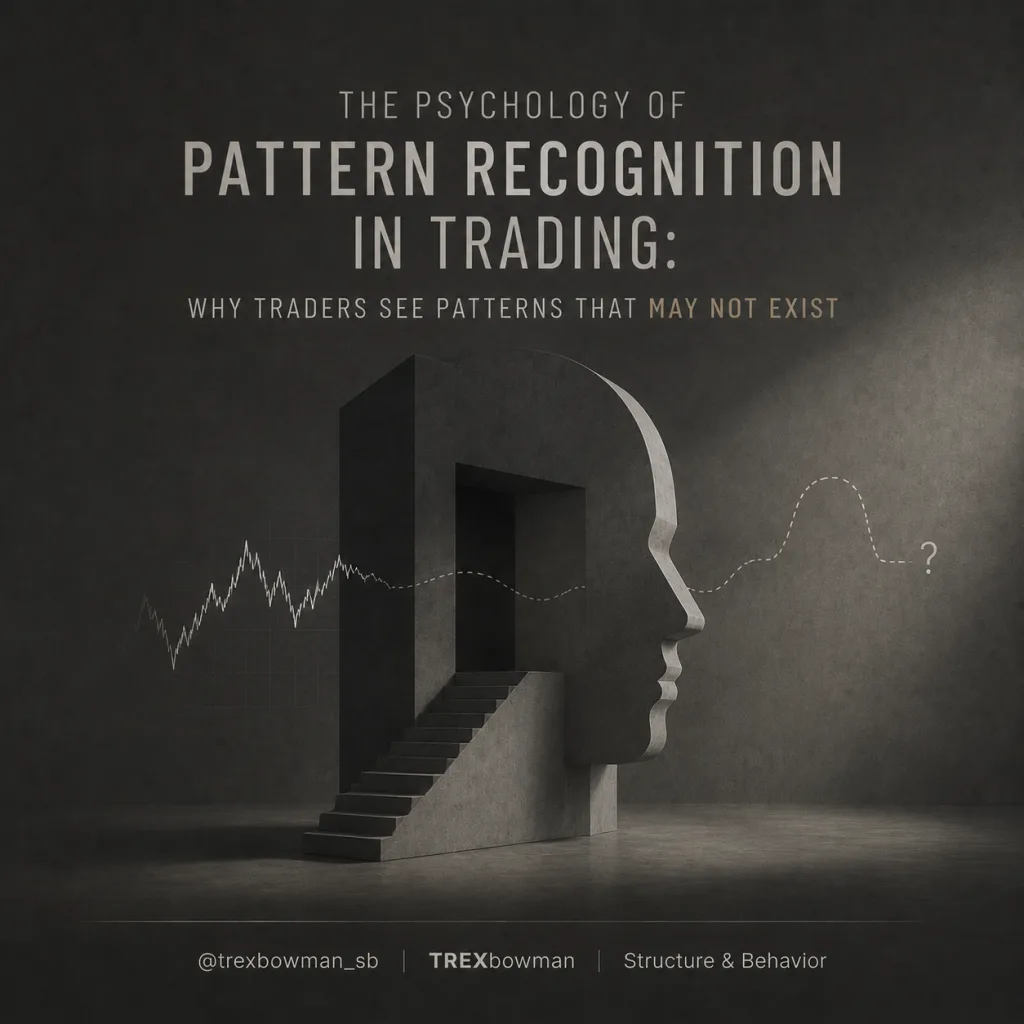
Introduction: Is the Trader Seeing the Market or the Mind’s Interpretation of It?
One of the most important abilities of the human brain is the ability to recognize patterns in complex environments. The human mind is constantly searching for relationships, structures, and connections within large amounts of information. This ability has helped humans learn from past experiences, identify risks, and make decisions about the future.
However, the same ability can become a challenge in financial markets.
When a trader looks at a chart, they are not only observing price movement. They are also interacting with their own experiences, beliefs, expectations, and previous interpretations. Sometimes this ability allows traders to recognize meaningful market structures. But at other times, the mind begins to create connections that may not actually exist.
This leads to an important question:
Is the trader truly recognizing a pattern that exists in the market, or is the mind imposing a pattern onto the available data?
The difference between these two processes is one of the most important boundaries between professional analysis and cognitive interpretation.
Why Does the Human Brain Search for Patterns?
The human brain evolved to identify order within the surrounding environment. In the real world, quickly recognizing patterns was a significant survival advantage. Detecting a specific sound, identifying a safe path, or predicting the behavior of another individual all depended on the brain’s ability to find meaningful patterns.
However, financial markets are not the same environment in which these abilities originally developed.
In markets, traders interact with a system created by the interaction of millions of human decisions, algorithms, economic conditions, and unknown variables. In such an environment, a similarity does not always represent a meaningful relationship.
The human mind naturally prefers a world that appears organized and explainable. When faced with complex information, it often attempts to create meaning, even when the underlying data may be random.
This ability is not a problem by itself.
The problem begins when traders forget that every pattern they see is not necessarily a real trading advantage.
Financial Markets: An Environment Where Pattern Recognition Becomes Difficult
In many areas of life, repeated patterns can indicate stable relationships. Financial markets, however, operate under different conditions.
The market is not a fixed system that follows a simple and repetitive rule. Price behavior emerges from the interaction of multiple factors, which means that a similar movement at two different points in time may produce completely different outcomes.
For example, a chart pattern may lead to a successful move under a specific market condition, while the same pattern may fail under different circumstances.
The reason is not that the pattern has no value.
The problem is that the pattern is being analyzed outside of its context.
A professional trader does not only ask:
“Has this shape caused a price movement before?”
Instead, a deeper question is asked:
“Under what conditions did this pattern form, and what type of behavior created it?”
Apophenia: When the Mind Finds Meaning in Random Data
One important concept in cognitive science is Apophenia. It refers to the human tendency to perceive connections and patterns in data that may not actually have a meaningful relationship.
This phenomenon is extremely common in trading.
A trader may study historical price movements and notice similarities between several market moves. The mind then begins creating a rule:
“Whenever this happens, the market should move in the same direction.”
The problem is that the human brain tends to remember examples that support its assumptions while paying less attention to situations that contradict them.
As a result, the trader may believe they have discovered a real market relationship when, in reality, they have created a mental story about the market.
The Difference Between Pattern Recognition and Pattern Creation
One of the most important boundaries between professional analysis and cognitive error in trading is the difference between recognizing a real pattern and creating a pattern through the mind’s interpretation.
A professional trader does not search for every possible similarity on a chart. They understand that the human brain naturally tries to connect unrelated information. Therefore, before accepting a price behavior as a meaningful pattern, they evaluate it within a specific framework.
The question is not simply:
“Have I seen something similar before?”
The deeper question is:
“Does this behavior have meaning within the current market structure and context?”
On the other hand, a trader affected by cognitive bias may first develop a mental conclusion and then search for evidence to support it. In this situation, the mind is no longer analyzing the market objectively; it is trying to align available information with a previous belief.
In professional decision-making, the process begins with observing market reality, evaluating evidence, analyzing conditions, and then making a decision.
In a biased decision-making process, the starting point is often a previous belief or expectation. The mind then searches for supporting evidence and creates a narrative that makes the original belief appear logical.
The difference between these two paths is critical.
In the first case, the trader attempts to understand the market.
In the second case, the trader attempts to make the market fit an idea that already exists in their mind.
Why More Experience Does Not Always Create Better Vision
It is often assumed that the more experience a trader gains, the better they become at recognizing patterns.
This is partly true, but there is also a hidden risk.
Experience can work as a filter. An experienced trader may notice details that a beginner cannot recognize. However, the same experience can also create excessive confidence.
The human mind naturally tends to treat past experiences as possible rules for the future.
In financial markets, this can become dangerous.
The past is only a collection of examples, not a guarantee of future outcomes.
A professional trader uses experience as a source of information but does not allow experience to become absolute certainty.
The Role of Confirmation Bias in Misinterpreting Patterns
One of the most important cognitive biases related to pattern recognition is Confirmation Bias.
The human mind naturally prefers information that supports existing beliefs.
For example, if a trader expects a price increase, they may focus primarily on signals that support their bullish scenario while ignoring evidence that challenges it.
In this situation, the problem is not a lack of information.
The problem is that information is not being processed objectively.
This is the point where a trader may believe they are analyzing the market while actually defending a previous belief.
The Relationship Between Pattern Recognition and Structure & Behavior
In the Structure & Behavior approach, the goal is not to find as many patterns as possible.
The goal is to understand the relationship between market structure and price behavior.
Structure helps the trader understand the broader market position and possible paths.
Behavior reveals how price moves within that structure, the quality of the movement, its strength or weakness, and whether price action aligns with the current scenario.
From this perspective, a price pattern has no meaning by itself.
A structure without behavior is incomplete.
And behavior without understanding structure can lead to incorrect interpretations.
Therefore, a professional trader does not search for more patterns. Instead, they seek a deeper understanding of the context in which those patterns appear.
Why Similar Patterns Do Not Always Produce Similar Results
One common mistake in trading is confusing visual similarity with actual similarity.
Two charts may look similar on the surface, while the conditions behind their formation are completely different.
Differences in timing, market position, trader behavior, liquidity, and overall structure can change the final outcome.
The market is not a mechanical machine that produces the same result from the same input every time.
The market is a complex system.
In complex systems, patterns are usually probabilistic, not certain.
How Professional Traders Use Patterns
Professional traders do not try to eliminate pattern recognition. It is one of the most valuable tools in market analysis.
However, they approach patterns differently.
They see every pattern as a possibility, not a fact.
They analyze the conditions behind the pattern instead of focusing only on visual similarity.
They create scenarios instead of making absolute predictions.
Most importantly, they understand that the value of a pattern does not come from the pattern itself. Its value comes from its position within a structured decision-making framework.
Conclusion: Seeing More Does Not Always Mean Understanding More
The ability to recognize patterns is one of the most important characteristics of the human mind. However, in financial markets, the same ability can also become a source of error.
A trader may believe they are observing market reality while actually observing their own mental interpretation.
The difference between professional analysis and analytical illusion is not the number of patterns a trader can find. It is the ability to evaluate whether those patterns actually contain meaningful information.
The market does not reward traders who find the most patterns.
It rewards traders who understand which patterns deserve attention and which ones are only creations of the mind.
The most important question is not:
“How many patterns can I find on a chart?”
The deeper question is:
“Does the pattern I see actually exist in the market, or was it created by my own mind?”
@trexbowman_sb | TREXbowman | Structure & Behavior