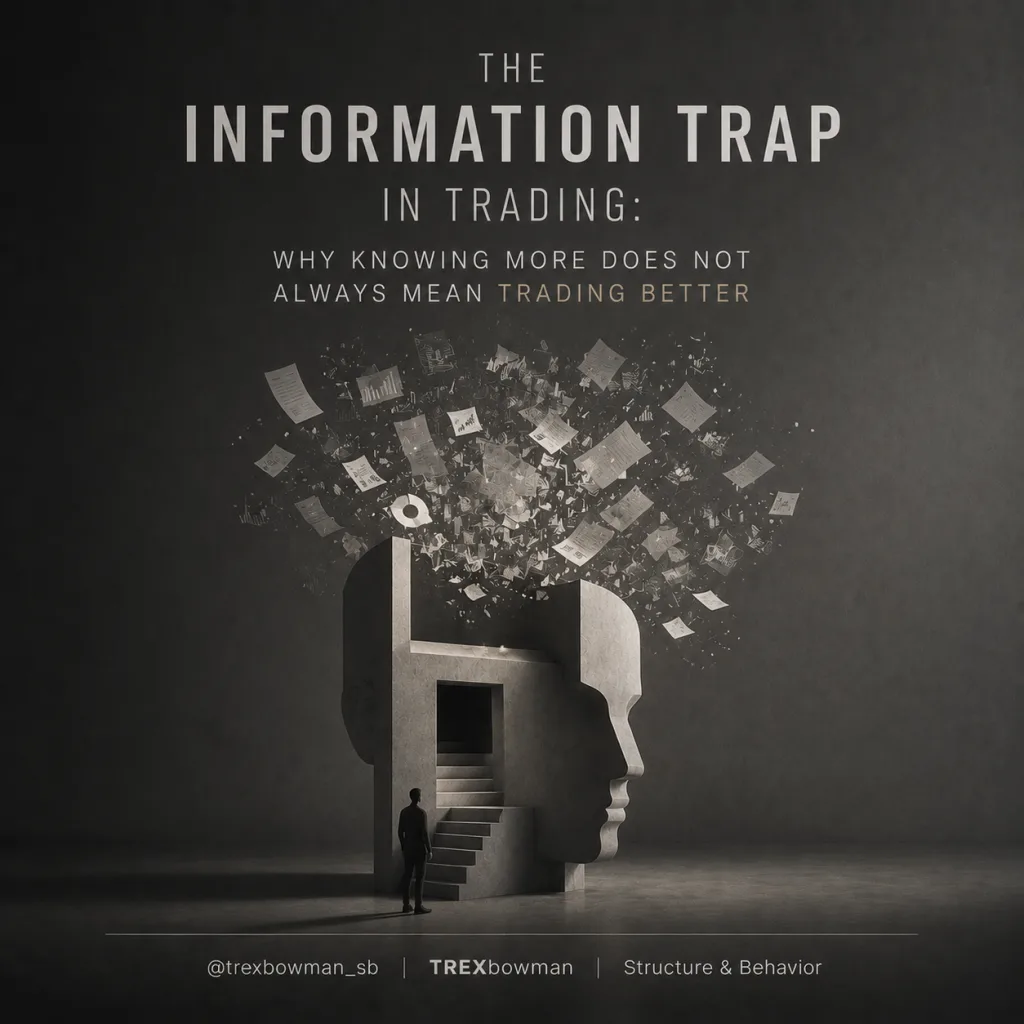
In the world of trading, there is a powerful and widely accepted belief: the more information we have, the better decisions we can make.
Because of this belief, many traders spend a significant part of their journey collecting more information. They read more books, watch more courses, follow more analyses, and constantly search for new methods, tools, or perspectives that can provide them with greater confidence.
But an important question remains:
If more information always leads to better performance, why do many traders continue repeating the same mistakes even after years of learning and studying?
Why does a trader with less information sometimes make a simpler and more rational decision, while another trader who has learned dozens of methods and concepts becomes uncertain at the moment of execution?
Perhaps the main problem is not a lack of information. Perhaps the deeper issue lies in how information is processed and transformed into decisions.
The market is not an environment where the person with the most information becomes the most successful. The market is an environment where the quality of decision-making under uncertainty determines the outcome.
Information, Knowledge, and Decision: Three Different Concepts
One of the most common mistakes in trading is treating information, knowledge, and decision-making as the same thing.
Information is the data we receive. Price movements, news, market analysis, chart patterns, opinions, and thousands of other inputs belong to this category.
However, having information does not necessarily mean having knowledge. Knowledge is created when a person can understand relationships between different pieces of information, organize them, and identify what truly matters among a large amount of data.
Yet even knowledge alone is not enough.
The final stage is decision-making.
A trader must be able to take action based on available information while the outcome remains uncertain. This is where the difference between a person who is simply informed and a professional trader becomes clear.
A trader may possess a tremendous amount of information and still have poor decision-making skills. The market does not reward those who collect the most data; it rewards those who can correctly interpret meaningful information and make appropriate decisions at the right time.
Why Does the Human Mind Seek More Information?
The human mind is naturally uncomfortable with uncertainty.
Throughout history, the ability to recognize patterns and anticipate future events has been an important survival mechanism. The brain constantly attempts to make the surrounding environment more understandable and controllable.
Financial markets are exactly where this mental tendency is challenged.
A trader operates in an environment where no outcome is guaranteed. Even the strongest analysis can fail, and even the most effective systems can experience losing periods.
Under these conditions, the mind may search for a simple solution:
“If I have more information, perhaps I can reduce uncertainty.”
This is why traders begin collecting more and more information. They follow another analyst, learn another strategy, test another indicator, or search for additional reasons to feel more confident about their decisions.
But the problem is:
More information does not always reduce uncertainty. Sometimes it only increases the number of possible scenarios.
How Does the Information Trap Develop in Trading?
The information trap appears when a trader believes that the main reason for their difficulties is still a lack of knowledge.
In this situation, every trading mistake is interpreted as an educational problem rather than a decision-making problem.
The trader starts thinking:
“I still do not know enough.”
“I need to take another course.”
“There must be a better system.”
“Maybe another analyst can solve my problem.”
As a result, instead of improving their mental model and execution process, they enter an endless learning cycle.
Learning itself is not the problem. The problem begins when learning becomes a substitute for real experience, observation, and decision-making.
Knowledge should be a tool for better execution, not a place to hide from execution.
When Information Becomes Noise
One of the biggest problems with excessive information is increasing complexity.
Imagine a trader who reviews multiple analyses before entering a trade. One analysis is based on market structure, another on news, another on indicators, and another on the opinion of a different analyst.
Every new piece of information can create a new scenario.
On the surface, the trader appears to have more knowledge. However, in reality, their decision-making ability may become weaker.
The reason is that the mind must choose between different inputs that may sometimes contradict each other.
At this stage, the problem is no longer a lack of information. The problem is the inability to distinguish important information from irrelevant information.
A professional trader is not someone who follows everything. A professional trader knows what should be ignored.
The Connection Between the Information Trap and Cognitive Biases
Excessive information can strengthen certain cognitive biases.
One of the most important examples is Confirmation Bias.
The human mind naturally prefers information that confirms existing beliefs.
For example, a trader who has already decided that price will move upward may unconsciously focus only on the data that supports their bullish scenario while ignoring contradictory evidence.
In this situation, more information does not necessarily create better understanding. It may simply provide more material to defend an incorrect belief.
The real problem is not that the trader lacks information. The problem is how the mind selects and interprets information.
Why Do Traders With Extensive Knowledge Still Make Mistakes?
Knowing a concept is not the same as being able to execute it.
Many traders understand that they should not take excessive risk, yet they violate this principle under pressure.
Many understand that the market is uncertain, yet they continue searching for an analysis that gives them complete confidence.
Many have studied risk management, yet their behavior changes when they face real losses.
This gap between knowing and doing is one of the greatest challenges in trading.
The market does not only measure theoretical knowledge. It measures the ability to transform knowledge into decisions and execute those decisions under pressure.
The Relationship Between the Information Trap and Structure & Behavior
In the Structure & Behavior approach, the goal is not to collect unlimited amounts of information.
The goal is to understand the relationship between market structure and price behavior.
Structure helps the trader understand the potential path of the market.
Behavior reveals how price moves along that path and the quality of that movement.
However, even the strongest structural and behavioral analysis cannot produce results without a proper decision-making process.
Information becomes valuable only when it exists within a framework.
Without a framework, more information can simply create more noise.
The Difference Between a Professional Trader and Someone Trapped in Information
A trader trapped in the information cycle constantly feels that they are not ready yet.
They study more instead of deciding.
They analyze more instead of executing.
They search for certainty instead of working with probabilities.
A professional trader understands that the market will never provide all the information required for complete certainty.
Instead of trying to eliminate uncertainty, they learn how to make decisions within it.
Instead of trying to have the maximum amount of information, they focus on identifying the most important information.
Knowledge Should Be a Tool, Not an Identity
Learning and studying are essential parts of a trader’s growth.
However, there is an important boundary.
When knowledge changes from a tool for better decision-making into a part of a person’s identity, the problem begins.
At that point, a trader may become more interested in knowing about the market than actually facing the market.
This is where knowledge stops creating an advantage and becomes a comfort zone.
The difference between a professional trader and someone trapped in this cycle is not the amount of information they possess; it is their relationship with information.
Conclusion
Success in trading does not come from having the greatest amount of information.
The market does not guarantee success to those who know more.
A real advantage is created when a trader can process available information through a logical framework, recognize the importance of each piece of data, and make decisions under uncertainty.
Ultimately, the important question is not:
“How much information do I have?”
The more important question is:
“How effectively can I transform available information into a high-quality decision?”
@trexbowman_sb | TREXbowman | Structure & Behavior