
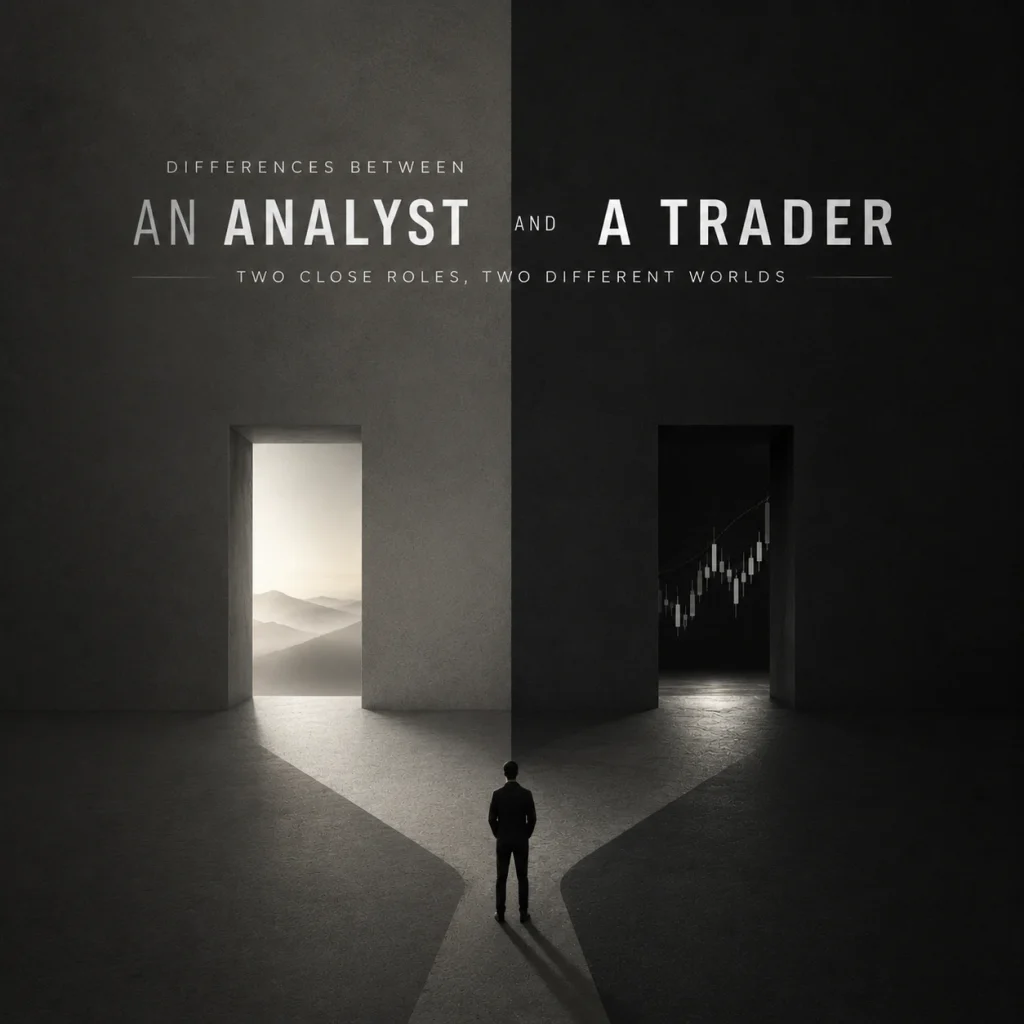
In financial markets, one of the most common misconceptions is that many people assume an analyst and a trader are the same person with two different titles; or even worse, they believe that anyone who provides good analysis must necessarily also be a successful trader.
In reality, although these two roles are closely related and intersect at certain points, they represent two fundamentally different worlds in terms of nature, responsibility, skillset, mindset, psychological pressure, and success metrics.
Understanding this difference is not merely theoretical. If this boundary is not clearly defined, both analysts and traders are judged unfairly, and market participants develop incorrect expectations.
Many disagreements, misunderstandings, and misjudgments in the market originate exactly from this point: where people confuse “the one who reads the market” with “the one who takes risk on the market.”
Who is an Analyst?
An analyst is someone who reads the market, interprets it, and explains its structure.
They look at data, charts, price behavior, trading volume, key levels, trends, economic news, or fundamental variables, and try to extract an underlying order from apparent chaos.
The analyst’s work, before execution, is understanding. They aim to see where the market stands, what scenarios lie ahead, which areas are important, and under what conditions price movement in a given direction becomes more probable.
An analyst essentially works with probability, not certainty. Although in Trex Price Action there are structural zones of certainty, in general an analyst does not say the future will definitely be a certain way; instead, they say that if conditions remain the same, a specific scenario becomes more likely.
For this reason, analysis is primarily the art of interpreting uncertainty.
Who is a Trader?
In contrast, a trader is someone who must take a real financial decision out of this uncertain and probabilistic environment.
They cannot simply build scenarios and leave all paths open. Ultimately, they must decide: buy, sell, or not enter the trade at all.
This decision, unlike analysis, is not theoretical or mental; it involves real money, real risk, and real consequences.
If an analyst works with the mind, a trader works with nerves, discipline, and capital.
An analyst may present multiple possible scenarios, but a trader can only execute one of them.
An analyst explains probabilities, but a trader must live with one of those probabilities.
Superficial Similarity, Fundamental Difference
The reason these two roles are often confused is that both deal with charts, both talk about the market, and both use concepts such as trends, levels, breakouts, pullbacks, support, and resistance.
However, behind this superficial similarity lies a deep difference:
- The analyst’s role is to understand and explain the market.
- The trader’s role is to act in the market and accept responsibility for decisions.
This is not a small difference.
It is the boundary between “understanding” and “execution.”
Difference in Nature of Work
Analysis is fundamentally interpretative work.
Trading is fundamentally decision-making work.
An analyst is like someone drawing a route map. They identify possible paths, risks, obstacles, and key points.
A trader, however, is the one who must wear the shoes, walk the path, take risks, fall, and stand up again.
This means that even when both look at the same map, their experience of the market is completely different.
An analyst might say:
If price breaks this level, the probability of an upward move increases.
If this area is not held, the likelihood of a correction or reversal increases.
But a trader must decide at a specific moment:
- Should I enter now or not?
- Where should the stop loss be?
- What position size should I use?
- If the market moves against me, what should I do?
- If it goes in profit, where should I exit?
This is where the real difference begins.
Difference in Responsibility
One of the most important differences is the level of responsibility.
An analyst does not usually generate direct financial outcomes. They provide a professional interpretation, not necessarily an executional action.
If an analysis is wrong, credibility may be questioned, but money does not necessarily leave their account.
A trader, however, is directly involved with capital.
Every wrong decision can lead to loss.
Every mistake has a real cost.
For this reason, the psychological burden and responsibility of trading are far heavier than they appear from the outside.
An analyst can think more calmly, more openly, and in a scenario-based way.
A trader must decide in real time, under pressure, with the possibility of error.
In simple terms:
The analyst faces the market; the trader faces both the market and themselves.
Difference in Skillset
Although these two roles are related, their core skills differ.
Core skills of an analyst:
- Understanding market structure
- Reading price behavior
- Interpreting data
- Distinguishing signal from noise
- Building scenarios
- Having a coherent analytical view
- Clearly explaining what they see
An analyst primarily needs observation, interpretation, and mental modeling ability.
Core skills of a trader:
- Risk management
- Emotional control
- Commitment to a system
- Real-time decision making
- Controlling greed, fear, and impatience
- Accepting stop losses
- Preserving capital
- Knowing when not to trade
A trader primarily needs discipline, psychological control, patience, precise execution, and capital management.
For this reason, someone may be an excellent analyst but fail as a trader due to emotional weaknesses.
Conversely, someone may not produce complex analysis but still become a profitable trader due to discipline and execution quality.
Difference in Handling Uncertainty
Markets are inherently uncertain (except in certain structural cases in Trex methodology).
No one knows the future with certainty.
Everything is probability.
An analyst accepts this uncertainty and expresses it in scenario form.
They speak in probabilities instead of certainty.
A trader, however, must commit real money within those probabilities.
This means the trader is not only dealing with the market, but also with fear of loss, temptation of profit, cognitive bias, time pressure, and capital fluctuations.
The analyst says:
“This scenario is X percent more likely.”
The trader must say:
“Even though I am not certain, I will enter based on my system, and if it fails, I will exit with a limited loss.”
This is a significant difference.
Difference in Objective
The analyst’s objective is not necessarily direct profit generation.
Their goal is to better understand the market and provide a meaningful interpretation of it.
The trader’s objective is entirely operational:
- capital preservation,
- risk management,
- and achieving consistent profitability.
For an analyst, a correct and insightful analysis is success.
For a trader, a structured and profitable system is success.
A technically correct analysis may still result in a loss if execution is poor.
Conversely, a simple analysis can result in a successful trade if execution and management are strong.
In markets, correct thinking and correct execution are two different things.
Difference in Psychological Pressure
Analysis involves cognitive pressure.
Trading involves psychological pressure.
An analyst needs clarity of thought, accuracy, and reasoning ability.
A trader must also be psychologically resilient.
Many people understand the market well, but when real money is involved, they lose control.
Fear leads to early exits, greed leads to holding too long, revenge trading leads to irrational entries, and a series of losses can destroy psychological discipline.
Therefore, trading is not just an analytical skill; it is also a psychological and behavioral skill.
Difference in Measuring Success
Success for an analyst is usually measured by:
- Did they correctly identify structure?
- Were the scenarios logical?
- Was the analysis coherent?
- Did they interpret market behavior correctly?
Success for a trader is measured by:
- Are they profitable in the long term?
- Did they control risk?
- Did they preserve capital?
- Did they remain consistent with their system?
- Did they learn from mistakes?
For this reason, someone may be a valuable analyst in educational or media contexts, but not necessarily a successful trader in personal execution.
Conversely, someone may be a disciplined and profitable trader without being interested in public analysis or education.
Why People Confuse the Two
There are several reasons:
- Both talk about the market.
- Both work with charts.
- Many beginners assume good analysis automatically leads to profit.
- Some confuse analysis with signals.
- In social media, the boundary between analysis and trading calls is blurred.
- People usually see outcomes, not the process behind them.
In reality, analysis is only one part of trading; an important one, but not sufficient on its own.
Can One Person Be Both?
Yes, but that does not mean the roles are identical.
Some people are both good analysts and good traders.
However, this is the result of mastering two different skill sets, not the natural outcome of them being the same role.
Like someone who is both a good architect and a good builder; it is valuable, but not automatic.
Many people are stronger in one area:
- Some understand the market very well but struggle with execution.
- Some execute very well but do not focus on analysis or teaching.
- Some only build scenarios.
- Some only execute systems.
This diversity is natural.
A Simple Example
An analyst is like a meteorologist.
They analyze data and say there is a high probability of rain, moderate probability of storms, or stable weather conditions.
A trader is like someone who must decide based on that forecast:
- Should I travel or not?
- Should I take an umbrella or not?
- Should I cancel plans or continue?
The meteorologist gives probability.
The decision-maker takes action.
The market works the same way.
Final Summary
An analyst and a trader are two closely related but distinct roles.
Both are essential and valuable to the market, but each has its own nature and requirements.
Analyst:
- Reads the market
- Understands structure
- Builds scenarios
- Interprets probabilities
- Deepens understanding
Trader:
- Makes decisions
- Takes risk
- Manages capital
- Controls emotions
- Produces results in execution
In simple terms:
The analyst says what the market can do;
the trader decides what they must do.
This is exactly the boundary that must be understood.
Until this boundary is clear, neither the analyst nor the trader nor the market itself is properly understood.
@trexbowman_sb | TREXbowman | Structure & Behavior