
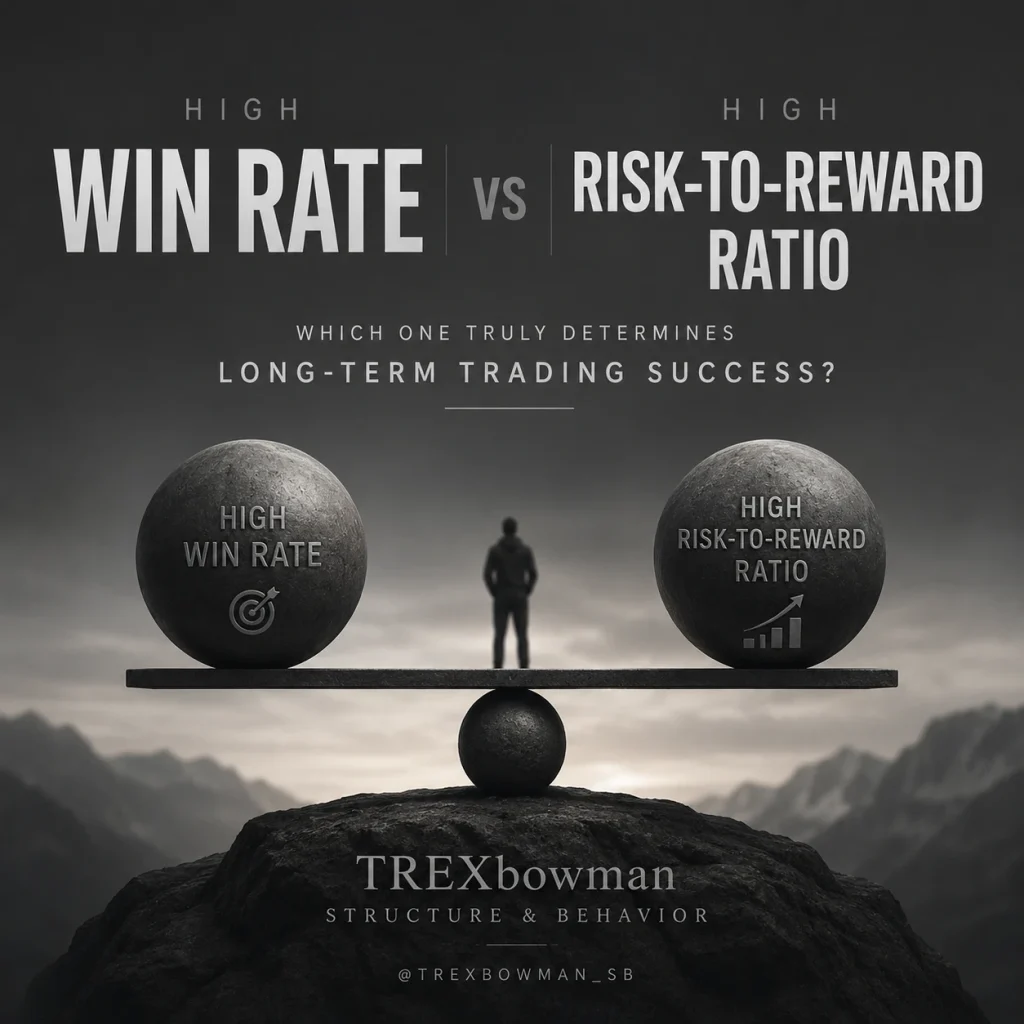
Win Rate vs Risk to Reward Ratio: Which One Matters More in Trading?
Introduction: The Long-Standing Debate in Financial Markets
One of the oldest debates in trading is the relationship between win rate and risk to reward ratio.
Many traders spend years trying to understand which factor plays a more important role in long-term trading success:
- Being right more often with a higher win rate
- Making larger profits when a trade is successful through a higher risk to reward ratio
At first glance, a high win rate appears more attractive. However, professional trading success is not determined by one metric alone. The real factor is whether a trading system has a sustainable statistical advantage.
What Is Win Rate in Trading?
Win rate represents the percentage of trades that close in profit compared to the total number of trades.
For example, a trader with 80 winning trades out of 100 total trades has an 80% win rate.
Advantages of a High Win Rate
A high win rate can provide several practical benefits:
- Greater confidence in trade execution
- Lower psychological pressure
- Fewer emotional reactions after losing trades
- Smoother equity curve progression
- Easier adherence to a trading plan
For many traders, frequent winning trades create a stronger sense of control and consistency.
Limitations of a High Win Rate
Despite its psychological advantages, a high win rate alone does not guarantee profitability.
If the average loss is significantly larger than the average profit, a few losing trades can eliminate the gains from many winning trades.
For example, a system that wins 9 out of 10 trades can still lose money if the single losing trade is large enough.
Therefore:
A high win rate without proper risk management is not a complete trading advantage.
What Is Risk to Reward Ratio in Trading?
The risk to reward ratio compares the potential loss of a trade with its potential profit.
For example:
- A 1:2 risk to reward ratio means risking $100 to potentially make $200.
- A 1:3 risk to reward ratio means risking $100 to potentially make $300.
Traders who focus on higher risk to reward ratios believe that profitability does not require being correct most of the time.
Advantages of a High Risk to Reward Ratio
A higher risk to reward approach allows traders to remain profitable even with a lower win rate.
For example, a system with:
- 40% win rate
- 1:3 risk to reward ratio
can still generate positive returns over a large sample size.
This approach is commonly used by many trend-following traders and investment strategies.
Limitations of a High Risk to Reward Ratio
Although mathematically attractive, this approach has psychological challenges.
A trader may experience:
- Multiple consecutive losses
- Long periods without significant gains
- Reduced confidence in the trading system
- The temptation to abandon the strategy too early
Many traders fail not because their system lacks an edge, but because they cannot psychologically tolerate its natural losing periods.
The Role of Expected Value in Trading
From a statistical perspective, the most important factor is not win rate or risk to reward ratio individually.
The key concept is expected value.
A trading system is profitable when its average expected outcome remains positive over a large number of trades.
In simple terms:
If the average profit generated by winning trades is greater than the average loss created by losing trades, the system can be profitable in the long run.
This means:
- A trader with an 85% win rate and a 1:1 risk to reward ratio can be profitable.
- A trader with a 40% win rate and a 1:3 risk to reward ratio can also be profitable.
The market does not reward a high win rate or a high risk to reward ratio by itself.
The market rewards a consistent statistical edge.
Win Rate vs Risk to Reward Ratio: Finding the Right Balance
The biggest mistake many traders make is trying to maximize only one factor.
Some traders focus entirely on achieving the highest possible win rate.
Others focus only on capturing very large winning trades.
However, the real objective should be building a trading system that is:
- Statistically profitable
- Psychologically sustainable
- Consistent with the trader’s personality
- Executable over the long term
A strategy that looks perfect on paper but cannot be followed consistently has no practical value.
The Psychological Side of Trading Performance
Trading is not only a mathematical process. Human psychology plays a major role.
Many retail traders prefer strategies with higher win rates because frequent success creates less emotional pressure.
On the other hand, strategies based on large risk to reward ratios require:
- More patience
- Stronger discipline
- Greater tolerance for losing streaks
The best trading system is not necessarily the one with the highest win rate or the largest reward potential.
It is the one a trader can execute consistently without breaking their rules.
Conclusion: What Really Matters in Trading Success?
A professional trader is not someone who is always right.
A professional trader is not someone who always captures the biggest market moves.
A professional trader is someone who can maintain profitability over the long term through discipline, consistency, and proper risk management.
The ultimate goal in trading should not be maximizing win rate or maximizing risk to reward ratio.
The real goal is building a sustainable trading system with a positive mathematical expectancy that can survive different market conditions over time.
@trexbowman_sb | TREXbowman | Structure & Behavior
One Response