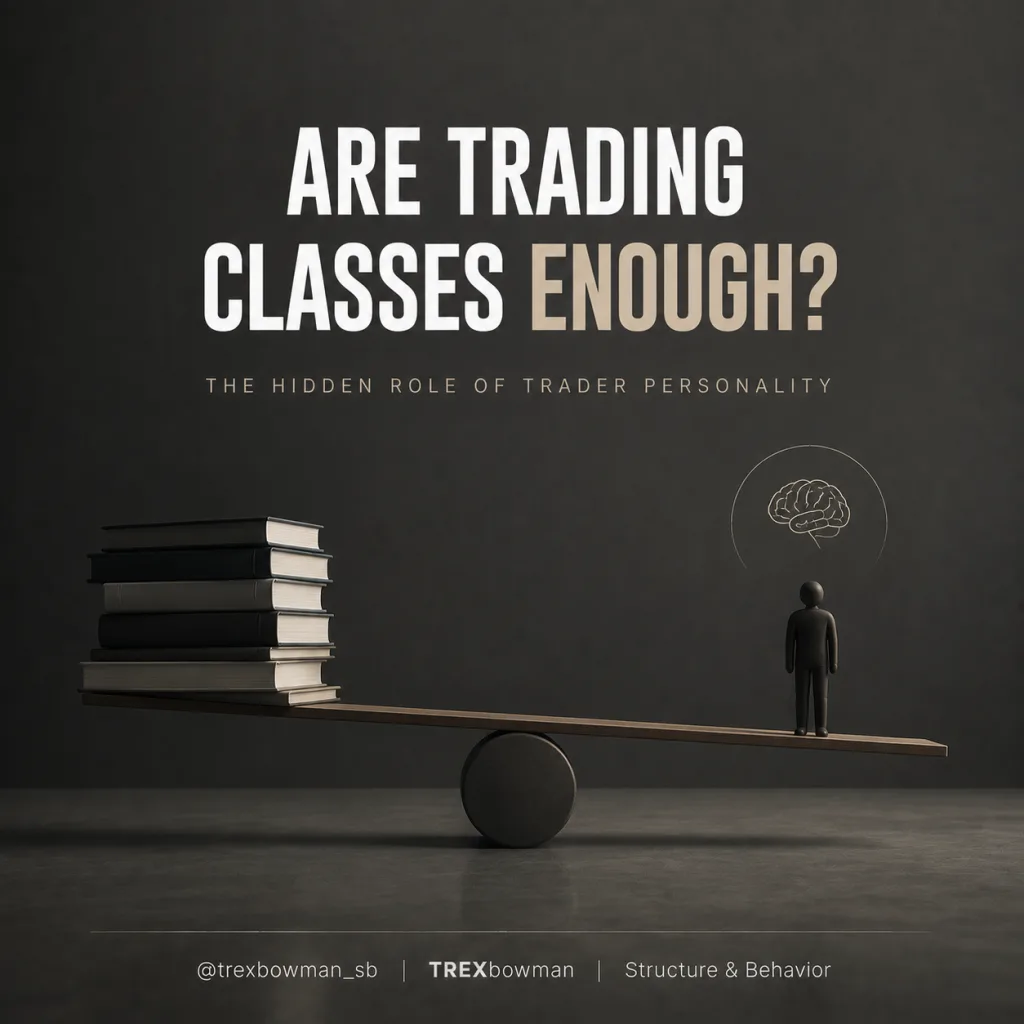
This statement may sound strange to many people, but there is a simple question:
Why do some people, even after completing multiple trading courses, still cannot make decisions like professional traders?
Is the problem a lack of education?
Is the problem the absence of a trading strategy?
Or perhaps there is an important step before all this education that almost nobody talks about?
The Hidden Problem in the Path of Trading Education
Many people enter trading classes directly before knowing whether they are actually suitable for trading or not.
They learn:
Where to enter
Where to exit
How to analyze charts
How to build a trading system
But fewer people first examine:
What type of personality does this person have?
Does this person have the ability to make decisions under uncertainty?
Is this person compatible with risk?
Is this career actually suitable for them?
Are they patient, or are they always looking for quick results?
Are they suitable for short-term trading, or are longer-term styles better for them?
Is their personality aligned with scalping and fast decisions, or with calmer and more patient trading approaches?
Can they wait for hours for a suitable opportunity?
Do they remain logical after a loss, or do they enter emotional behaviors?
Trading Personality Assessment Before Entering the Market
Perhaps before trading classes, there should be another stage:
“Trading Personality Assessment Before Entering the Market”
Trading Personality Assessment
There is a missing place for this type of course in the path of trading education.
A course whose goal is not teaching entries and exits; rather, its goal is understanding the individual before entering a challenging path.
Before entering the market, a person should know:
Does this person have the necessary characteristics for trading?
Which trading style is more compatible with their personality?
Are they suitable for short-term trading or long-term trading?
In which situations are emotional decisions more likely to occur?
What are their biggest behavioral weaknesses?
Why Doesn’t Everyone Succeed With the Same Trading Style?
Because not everyone is built for the same path.
One person may perform better in fast-paced trading and moment-to-moment decisions.
Another person may succeed more through patience, deep analysis, and a long-term perspective.
One person may perform better with clear and mechanical rules.
Another person may be stronger in scenario analysis and flexible decision-making.
The Role of Self-Awareness and Psychology in Trading
The problem for many people is not that they have not received education.
There are many people who have completed various courses, learned different styles, and become familiar with different methods; yet they are still stuck at the beginning of the path.
The problem is that they entered a path without understanding themselves, a path that may not be aligned with their personality traits.
A large part of failures does not happen because of not knowing a new strategy, but because of the inability to properly execute the knowledge that a person has already learned.
You can learn a trading setup and become successful with it, but another person may not achieve the same result with the same setup.
Why?
Because behind every trade, there is not only a strategy;
There is a human being with a different personality, beliefs, fears, and behavioral patterns.
The market does not only test knowledge and skills.
The market also tests the personality of the decision-maker behind those skills.
Before Learning a Trading Strategy, Know Yourself
Perhaps before someone asks:
“Which strategy should I learn?”
They should first answer:
“Am I suitable for this path, and what type of trading is more compatible with my personality?”
@trexbowman_sb | TREXbowman | Structure & Behavior