Introduction
In financial markets, many traders believe that the greatest advantage comes from having access to more information, using more advanced analytical tools, or developing a more complex trading strategy. However, in many cases, the real difference is not the amount of information a trader possesses, but the quality of decision-making under uncertainty.
Markets are environments where no outcome is guaranteed. Every price movement is the result of millions of decisions, expectations, fears, hopes, and different interpretations interacting with each other.
Despite this complexity, the human mind naturally attempts to simplify the market. It searches for clear answers, predictable paths, and a sense of certainty. This psychological need for certainty is one of the main factors behind the formation of Herd Behavior in financial markets.
What Is Herd Behavior in Financial Markets?
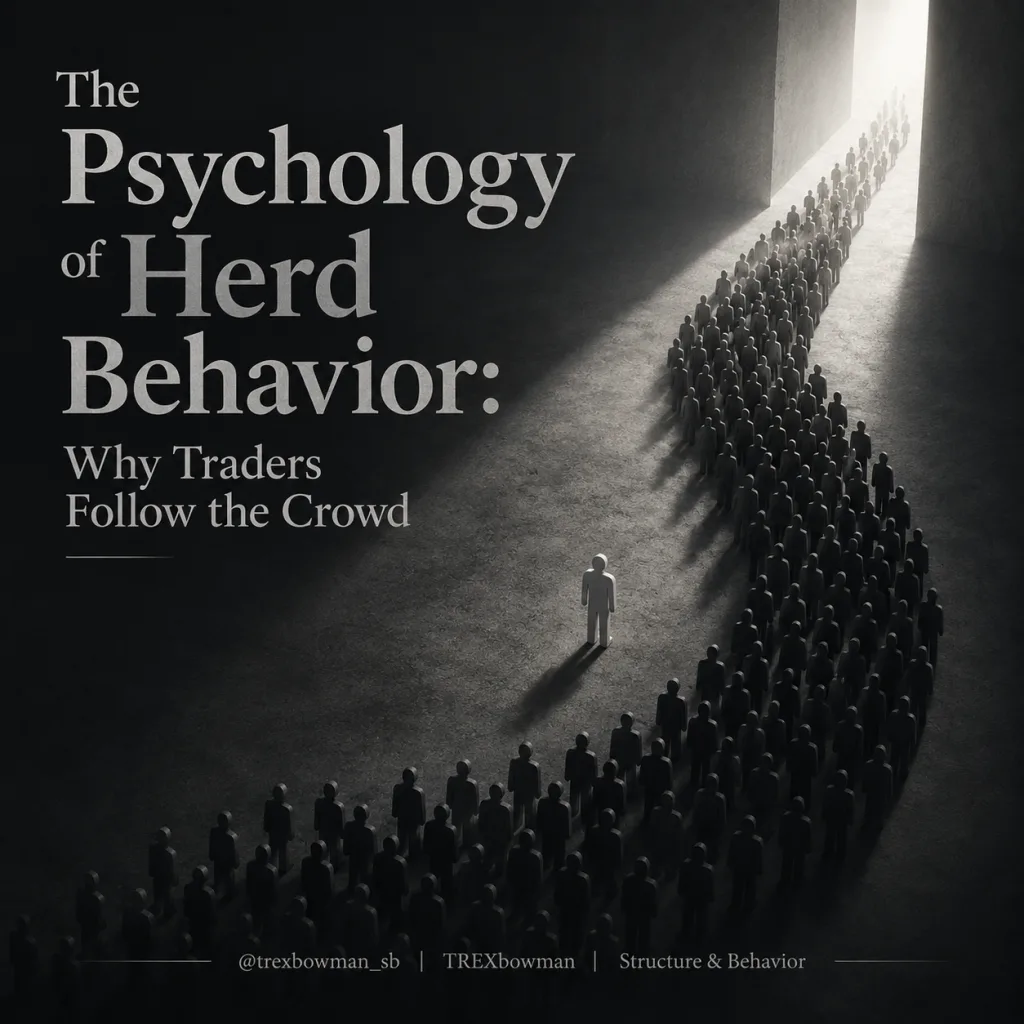
Herd behavior occurs when individuals adjust their decisions based on the actions, beliefs, or opinions of a group instead of relying on independent analysis.
In financial markets, this phenomenon can appear in different forms:
- Entering trades simply because a large number of traders are taking the same position.
- Replacing personal analysis with the opinions of other traders.
- Buying during periods of extreme market enthusiasm.
- Selling during periods of collective fear.
However, herd behavior is not always the result of a lack of knowledge. Even experienced traders can become influenced by collective behavior when they face uncertainty, incomplete information, and psychological pressure.
The Root of Herd Behavior: The Mind’s Escape From Uncertainty
The human brain evolved to make fast decisions in uncertain environments. In many situations throughout human history, following the group could provide a survival advantage.
However, financial markets operate differently.
In markets, what the majority does is not necessarily a reflection of reality.
Sometimes the crowd is wrong; not because people lack information, but because individuals reinforce each other’s beliefs and strengthen a shared interpretation.
This process is known in behavioral science as Information Cascade — a situation where individuals rely on the decisions of others as evidence of truth rather than analyzing the available information independently.
Traders Often Do Not See the Market; They See Their Own Narrative
One of the most dangerous cognitive errors in market analysis is Narrative Bias — the tendency of the human mind to create stories and explanations.
The human brain naturally seeks patterns, causes, and meanings. When the price moves, the mind immediately tries to explain why it happened and what it means for the future.
The problem begins when an analyst stops observing the actual behavior of the market and starts defending a story created in their own mind.
Sometimes, an analyst is not reading the market; they are reading the story their mind created before the market revealed itself.
At this stage, new information is no longer evaluated to discover reality. Instead, it is filtered only to confirm an existing belief.
Why Do Traders Seek Confirmation From the Crowd?
Independent decision-making in financial markets is not easy.
When traders face multiple possible scenarios, the mind naturally tries to select one outcome as the truth. When other people share the same view, that belief often feels more reliable and secure.
However, the number of people who believe something does not determine whether that belief is correct.
Markets have repeatedly shown that major turning points often occur when collective expectations are no longer aligned with reality.
The crowd does not always represent the truth; sometimes it represents a shared assumption.
The Difference Between Professional Traders and Collective Behavior
A professional trader is not someone who always predicts the future correctly.
The real difference lies in having a structured decision-making process.
Professional traders understand that every analysis is a scenario, not a certainty.
Market structure reveals potential paths; market behavior reveals the quality of movement along those paths. But ultimately, it is the trader’s mind that must make decisions under uncertainty.
The challenge of trading is not predicting the future; it is making rational decisions in an environment where the future can never be completely known.
Conclusion
Herd behavior is one of the most important concepts in trading psychology because it reveals that the biggest challenge for traders is not always the market itself; it is the way the human mind processes information and makes decisions.
The market does not try to convince us of anything. It simply reflects the interaction of millions of human decisions.
A professional trader is not someone who avoids the crowd because they believe they are always right. A professional trader is someone who can analyze evidence, evaluate probabilities, and make independent decisions without becoming dependent on collective opinions.
In the end, trading success is not built on knowing every answer. It is built on developing a decision-making framework that works even when certainty does not exist.
@trexbowman_sb | TREXbowman | Structure & Behavior