
Psychology
Introduction
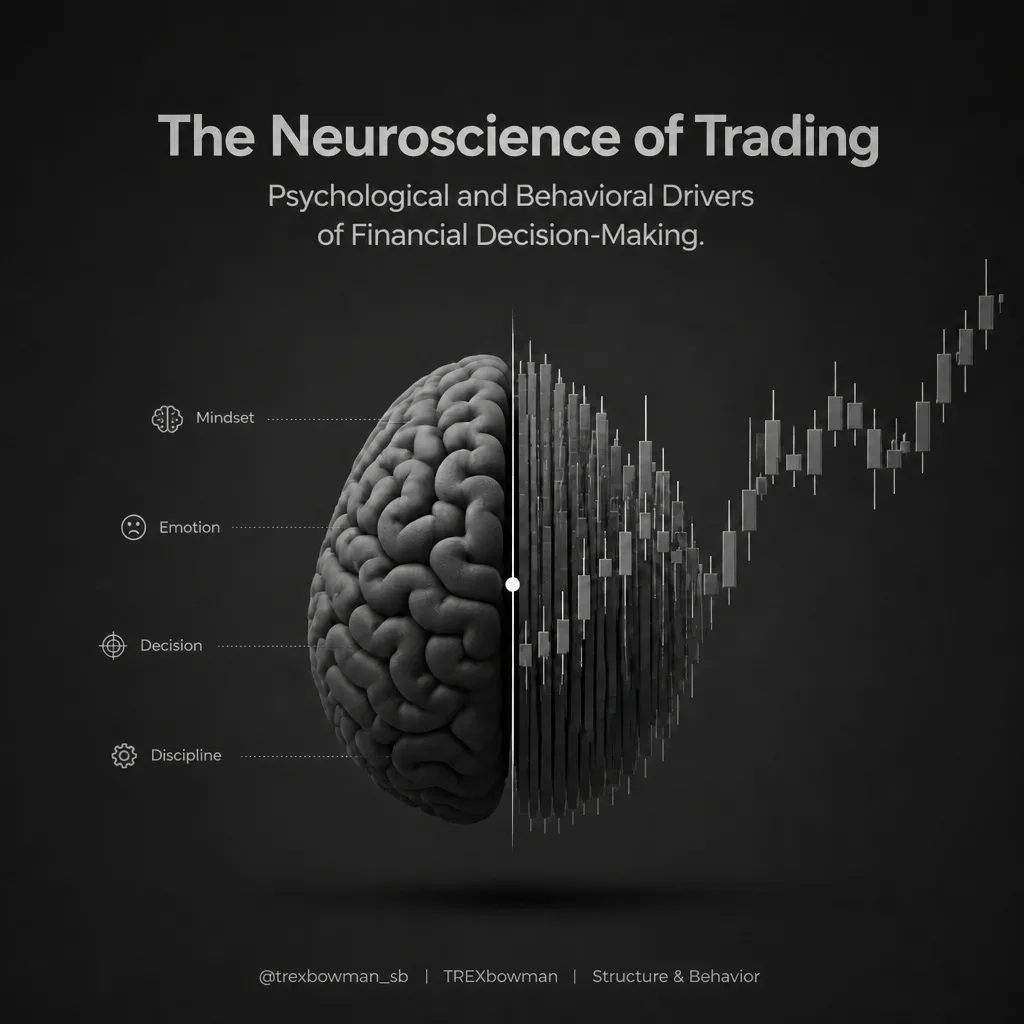
In financial markets, success in trading is not limited to economic knowledge, chart analysis skills, or the ability to recognize price structures. A significant part of a trader’s performance depends on how information is processed, how decisions are made under uncertainty, and how psychological responses are managed. Unlike many analytical activities, trading is an environment where human decisions are directly influenced by risk, volatility, time pressure, and the possibility of profit or loss.
Traders’ behavior is not solely the result of logical calculations; rather, it emerges from the complex interaction between the brain’s cognitive, emotional, and neural processes. Factors such as fear of loss, the desire for reward, overconfidence, and cognitive biases can significantly influence how information is evaluated and how financial decisions are made.
Neuroscience, through the study of neural mechanisms associated with perception, emotions, learning, and decision-making, seeks to provide a deeper understanding of human behavior in complex environments such as financial markets. Research in this field shows that the activity of different brain regions—particularly those involved in cognitive control, reward processing, and emotional responses—plays an important role in trading decisions.
This article explores the relationship between neuroscience and trading, examining how brain processes, psychological factors, and behavioral patterns influence the financial decisions made by traders.
1️⃣ Brain Function and Trading
The human brain plays a fundamental role in trading decisions. When traders engage in buying and selling activities, different regions of the brain become activated, supporting the processing of information, emotions, and decision-making mechanisms.
Key Brain Regions Involved in Decision-Making
Prefrontal Cortex
The prefrontal cortex is the brain region responsible for logical reasoning, decision-making, and information analysis. During trading activities, this area helps traders evaluate different types of information, including fundamental analysis and technical analysis.
In practice, the prefrontal cortex enables traders to process available data, assess potential outcomes, control impulsive reactions, and make more rational decisions under uncertain market conditions.
Reward System
The reward system consists of several brain regions, including the nucleus accumbens and the ventral tegmental area (VTA), which become activated when an individual experiences financial gains or successful outcomes.
Activation of this system generates feelings of satisfaction and pleasure, reinforcing certain behaviors. In trading, this mechanism can increase a trader’s desire to pursue further profits and may encourage greater risk-taking.
However, excessive activation of the reward system can also contribute to a cycle of risk-seeking behaviors, overconfidence, and greed, potentially leading traders to make decisions based more on emotional impulses rather than objective analysis.
2️⃣ The Impact of Emotions on Trading Decisions
Emotions play a critical role in the trading process and can significantly influence traders’ decisions. Many investors are affected by emotional factors such as greed and fear, which can lead to irrational decision-making and negatively impact trading performance.
Emotional Factors Affecting Trading
Greed
When a trader believes there is an opportunity to achieve greater profits, they may make more aggressive decisions that involve higher levels of risk. This emotional state can push traders toward excessive risk-taking, causing them to enter or maintain positions beyond reasonable limits.
Fear of Loss
Investors are often more concerned about losing capital than achieving profits. This fear can affect their ability to execute trades at appropriate price levels and may lead to premature exits, hesitation, or impulsive decisions.
In many cases, fear of loss prevents traders from following their original strategy and can result in decisions driven by emotional reactions rather than objective market analysis.
3️⃣ Market Volatility and Stress
Severe fluctuations in financial markets can increase stress levels among traders. Stress can negatively affect brain function and may lead to irrational decision-making and impaired judgment.
The Impact of Stress on Traders’ Behavior
Reduced Focus and Accuracy
Stress can interfere with traders’ ability to maintain concentration and attention, increasing the likelihood of analytical mistakes and inaccurate evaluations.
Changes in Emotional Responses
During periods of extreme market volatility, traders may respond to emotional impulses rather than relying on logical analysis. This can lead to poor decisions driven by fear, panic, or excessive reactions to market movements.
4️⃣ Analyzing Financial Behavior Through Neuroscience
Research in neuroscience helps provide a deeper understanding of trading behaviors and decision-making processes. By using techniques such as functional magnetic resonance imaging (fMRI) and electroencephalography (EEG), researchers can examine brain activity while individuals make financial decisions.
Improving Decision-Making Through Neuroscience
Identifying Behavioral Patterns
By analyzing brain activity and cognitive responses, researchers can identify different behavioral patterns among traders. This understanding can help in developing more effective financial strategies and improving decision-making processes.
Emotional Regulation
Understanding how emotions influence brain activity allows traders to develop methods for better emotional control and improved psychological management during trading.
5️⃣ Developing Effective Trading Strategies Through Neuroscience
Applying insights from neuroscience can contribute to improving trading approaches and enhancing decision-making quality. The following are some practical methods that traders can use:
Practicing Meditation and Mindfulness
Meditation and mindfulness practices can help traders improve emotional regulation and make better decisions under pressure. These techniques allow individuals to reduce emotionally driven thinking, increase self-awareness, and respond to market situations with greater rationality.
Developing Risk Management Strategies
Creating a structured risk management plan can minimize the negative impact of emotions on financial decisions. Using tools such as stop-loss orders can help traders prevent emotional interference and maintain more disciplined decision-making.
Using Data Analysis
Accurate data analysis and the use of analytical tools can help traders make more informed decisions based on objective information while reducing the influence of personal emotions and biases.
Conclusion
The relationship between neuroscience and trading demonstrates that financial decision-making is the result of a complex interaction between the brain’s cognitive, emotional, and behavioral systems. A trader’s performance does not depend solely on the ability to analyze market information; it is also influenced by the activity of different brain regions, the reward system, risk processing mechanisms, and responses to stressful stimuli.
Research in neuroscience and behavioral economics shows that factors such as fear of loss, the pursuit of rewards, cognitive biases, and psychological pressure can significantly affect probability assessment and the quality of decision-making. Understanding these processes helps traders identify their behavioral patterns and, through methods such as risk management, establishing a structured trading framework, and regulating emotional responses, develop more rational and consistent decision-making.
Despite scientific advancements in neuroscience, this field cannot predict future market behavior or provide a guarantee of trading success. Its primary role is to enhance our understanding of the neural and psychological mechanisms that influence human decision-making.
Ultimately, professional trading can be viewed as a combination of market knowledge, accurate information processing, and the ability to regulate behavior under conditions of uncertainty. A trader who can better manage the interaction between cognitive and emotional processes within the brain will have a greater ability to make stable, rational decisions in complex financial environments.
References
- Lo, A. W. (2004). The Adaptive Markets Hypothesis: Market Efficiency from an Evolutionary Perspective. Journal of Portfolio Management, 30(5), 15–29.
- Camerer, C., & Loewenstein, G. (2004). Behavioral Economics: Past, Present, Future. Advances in Behavioral Economics, 1–73.
- Montier, J. (2009). Behavioral Investing: A Practitioner’s Guide to Applying Behavioral Finance. Wiley.
- Mischel, W. (2014). The Marshmallow Test: Mastering Self-Control. Little, Brown and Company.
- Johnson, E. J., & Tversky, A. (1985). The Framing of Decisions and the Psychology of Choice. Science, 211(4481), 453–458.
- Thaler, R. H. (1994). The Winner’s Curse: Paradoxes and Anomalies in Economic Decision Making. Journal of Economic Perspectives, 8(2), 193–202.
@trexbowman_sb | TREXbowman | Structure & Behavior