
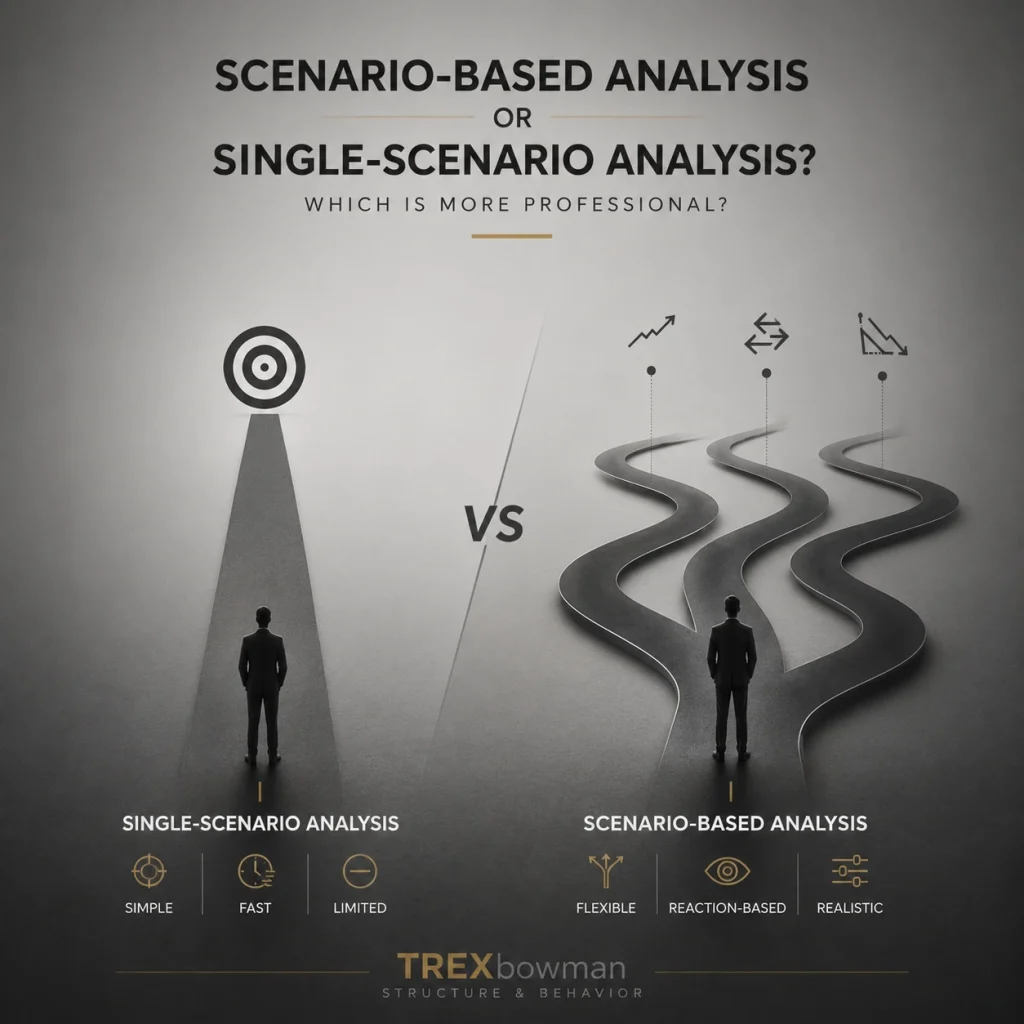
Introduction: Two Approaches to Understanding Market Behavior
In financial markets, analysts generally follow two different approaches when evaluating future price movements.
Some analysts rely on a single-scenario approach, where they define one expected path for price movement and build their decisions around that assumption.
Others use a scenario-based analysis approach, where they consider multiple possible outcomes and evaluate market reactions before making decisions.
The main difference between these two approaches is not simply prediction accuracy, but the ability to adapt to uncertainty and changing market conditions.
What Is Single-Scenario Analysis in Trading?
A single-scenario approach is a method where the analyst defines one dominant market expectation and considers it the primary path for future price movement.
For example, an analyst may determine that price is likely to rise after reaching a specific support level and create a trading plan based entirely on that expectation.
Characteristics of Single-Scenario Analysis
- Focuses on one predefined market direction
- Provides a clear and simple market view
- Easier to communicate and execute
- Can be effective in specific market conditions
Limitations of Single-Scenario Analysis
Despite its simplicity, this approach has important limitations:
- Reduced flexibility when market conditions change
- Higher dependence on the accuracy of the initial prediction
- Greater vulnerability during volatile market environments
- Difficulty adapting when price behavior contradicts expectations
Financial markets rarely move in a completely linear manner. Therefore, relying on only one fixed scenario can limit a trader’s ability to respond effectively.
What Is Scenario-Based Analysis in Trading?
A scenario-based analysis approach evaluates the market through multiple possible outcomes instead of assuming only one future path.
In this method, traders analyze important price levels and define possible reactions under different market conditions.
Rather than asking:
“Where will the market go?”
The trader focuses on:
“How will the market behave if a specific condition occurs?”
This approach shifts the focus from prediction to preparation.
Characteristics of Scenario-Based Analysis
A professional scenario-based approach includes:
- Evaluating multiple possible market scenarios
- Making decisions based on actual price reactions
- Adapting to changing market conditions
- Focusing on market behavior instead of absolute predictions
This approach is particularly relevant in methodologies based on market structure and price behavior, because markets are dynamic systems that continuously change based on supply, demand, liquidity, and trader positioning.
Challenges of Scenario-Based Analysis
Although scenario-based analysis provides greater flexibility, it requires more advanced analytical skills.
Its challenges include:
- Higher complexity compared to a single prediction
- The need for deeper market understanding
- Greater experience in evaluating price reactions
- More effort in creating and managing different scenarios
Scenario-Based Analysis vs Single-Scenario Analysis: Key Differences
| Single-Scenario Analysis | Scenario-Based Analysis |
|---|---|
| Focuses on one expected path | Considers multiple possible outcomes |
| Prediction-based | Reaction-based |
| Simpler and easier to communicate | Requires more analytical experience |
| Less flexible during uncertainty | More adaptable to market changes |
| Depends heavily on one assumption | Adjusts according to market behavior |
Which Approach Is More Professional?
Professional trading is not based on predicting the market with absolute certainty.
Uncertainty is an essential part of financial markets. Therefore, a professional analytical approach should be capable of adapting to different possibilities.
A single-scenario approach can provide clarity and simplicity, but it becomes vulnerable when the market moves differently from expectations.
A scenario-based analysis approach accepts uncertainty and builds decisions around real market reactions. This makes it more aligned with the actual behavior of financial markets.
Conclusion
The fundamental difference between Scenario-Based Analysis and Single-Scenario Analysis is flexibility.
Single-scenario analysis is simpler but more restrictive.
Scenario-based analysis is more complex but provides a more adaptive framework for dealing with uncertainty.
The less an analytical method depends on fixed predictions and the more it responds to actual market behavior, the closer it becomes to the true nature of financial markets.
@trexbowman_sb | TREXbowman | Structure & Behavior