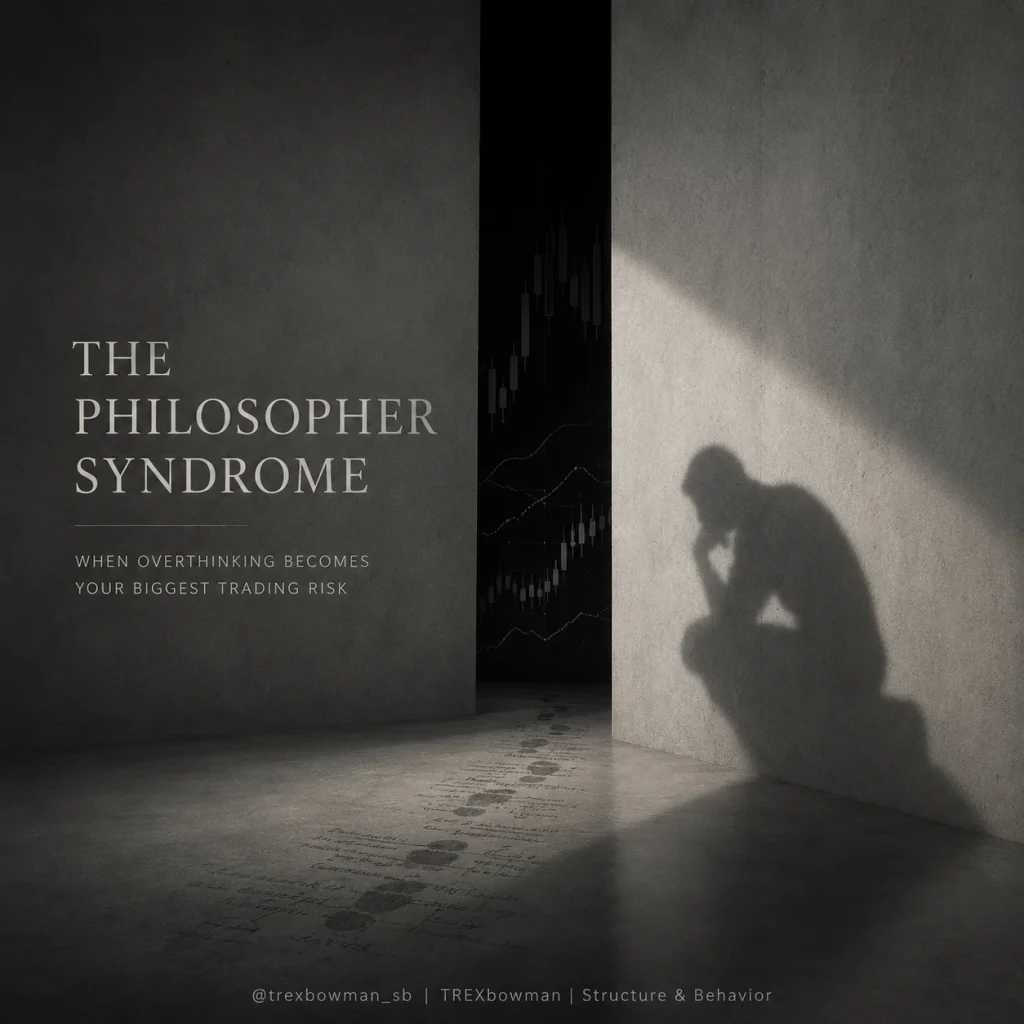
The Philosopher is not a person.
It is a mindset in the market.
Someone who talks about trading more than they actually trade.
Someone who reads about risk more than they ever takes it.
Someone who lectures on the psychology of loss before experiencing real losses themselves.
Some characteristics commonly found in this type:
• Addiction to Knowledge
Always reading another book, watching another video, or quoting philosophers. Knowledge has replaced action.
• Avoidance of the Real Market
The market is where the ego is broken—the illusion of control and superiority is shattered. Philosophers unconsciously prefer to remain in the world of theory rather than confront real failure.
• Turning Knowledge into Identity
Instead of using knowledge as a tool, it becomes part of their identity. They define themselves by the number of books they have read, not by the results of their trades.
• Endless Analysis Without Risk
Philosophers are masters at explaining the market after it has already moved. But when the moment of real pressure arrives, they cannot bring themselves to press the trade button.
• The Illusion of Depth
The more they read, the more convinced they become that the market is too complex to act in. As a result, they become trapped in an endless cycle of study.
The important point is this:
The Philosopher’s problem is not a lack of knowledge.
The problem is the lack of real exposure to the market.
The market is no place for philosophers.
It is a place for people who can live with uncertainty.
The Philosopher knows a great deal.
But risks very little.
Has read philosophy books.
Has memorized psychology.
Gives examples of cognitive biases.
Quotes Stoicism.
Quotes Mark Douglas.
Yet the account never grows.
Why?
Because action has been replaced with knowledge.
The Philosopher lives inside the comfort zone of knowing.
A place where no real money has to be on the line.
Where no real loss has to be absorbed.
Where there is no need to face the fear of entering a trade, the doubt after entering, or the pain of being stopped out.
Talks about emotional control.
Yet has never truly experienced a major loss.
Writes about accepting risk.
Yet has never traded meaningful size.
For a trader, knowledge is a tool.
For the Philosopher, it is an identity.
A real trader understands:
The market is not impressed by books.
It is not impressed by beautiful analysis either.
It rewards only the consistent execution of a statistical edge.
The Philosopher searches for certainty through knowledge.
A professional trader sometimes knows—and sometimes doesn’t.
The Philosopher seeks knowledge in books.
A trader’s knowledge is revealed on the chart.
The Philosopher keeps studying in order to become ready.
A trader keeps executing in order to become seasoned.
The Philosopher’s problem is not a lack of information.
The problem is information overload.
So much has been read that the courage to see the market simply has been lost.
So many concepts are understood that clear decisions can no longer be made.
Too much knowledge—
if it is not connected to execution—
becomes poison.
The market is not a university.
There are no written exams.
There are no grades for memorization.
It measures only one thing:
Your ability to execute your plan under pressure.
Philosophers are everywhere.
In trading groups.
In comment sections.
In endless discussions.
But rarely on the chart, trading real size.
If one day you notice that you study more than you trade…
That you write more analysis than you take risk…
That you explain more than you execute…
Be careful.
Perhaps the Philosopher within you has awakened.